
What Probate Is, and When Florida Requires It
A parent dies in Florida. There is a house, a bank account, maybe a condo, and you, the one handling it, live out of state. Within weeks you learn the bank will not release a dime and the title company will not touch the home until a court appoints you and, in most cases, a Florida lawyer files the case. You do not need a sales pitch. You need someone to take this off your plate, remotely, for a flat fee you can see before you commit. Not sure where to start? See what to do when a parent dies in Florida.
Probate is the court process that proves the will (or applies the rules for dying without a will if there is none), appoints a personal representative (Florida’s term for executor or administrator), pays valid creditors, and transfers what is left to the heirs or beneficiaries.
Only probate assets go through it: things in the decedent’s sole name with no beneficiary. Assets with named beneficiaries, joint-with-survivorship accounts, pay-on-death designations, a funded revocable trust, or a lady bird deed pass outside probate. The case is filed in the circuit court of the county where the decedent was domiciled at death, or, for a nonresident, where they owned property. Planning ahead? See how to avoid probate in Florida →
The Three Doors: Which Kind of Administration Applies
Most Florida estates pass through one of three doors, and the cheapest one may be open for you. Find out which probate you need →
Swipe the table sideways to compare all three paths.
| Path | When it fits | Speed |
|---|---|---|
| Disposition without administration (§735.301) | Only exempt personal property plus final-expense reimbursement; no real estate | Days to weeks |
| Summary administration (§735.201) | Estate $150,000 or less (raised from $75,000 on July 1, 2026) (after exempt property), or decedent dead more than 2 years | Weeks to ~2 months |
| Formal administration (ch. 733) | Everything else; a PR is appointed and the §733.6171 fee schedule applies | ~6 to 12+ months |
A common search, answered: Florida has no general “small estate affidavit.” The functional equivalents are summary administration and disposition without administration. If that’s what you came looking for, one of these is what you need. Check if the estate qualifies in 60 seconds → · the "small estate affidavit" explained →
Formal Administration, Step by Step
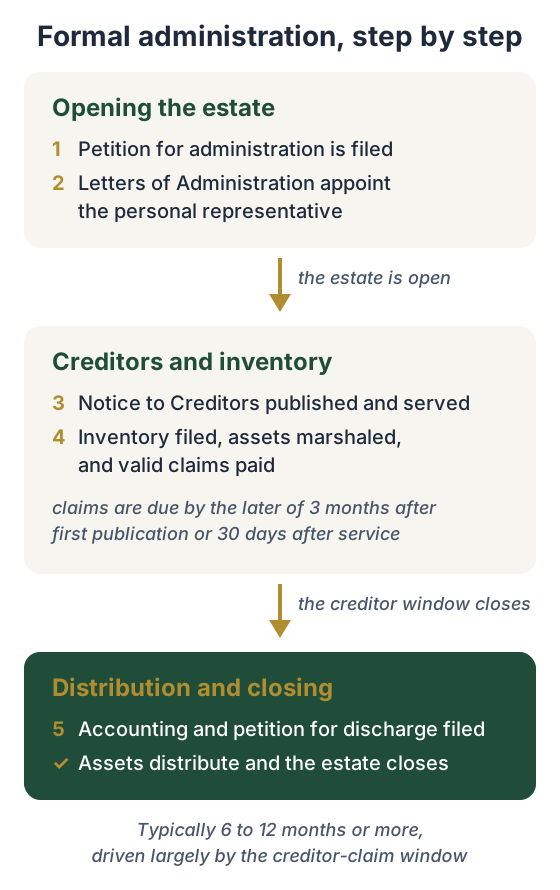
- Petition for administration: any interested person may petition.
- The court issues Letters of Administration appointing the personal representative.
- The personal representative publishes a Notice to Creditors and serves known creditors.
- The personal representative files the inventory, marshals assets, and pays valid claims.
- After the creditor window closes, the personal representative files an accounting and a petition for discharge. The assets distribute and the estate closes.
How Long Does Probate Take in Florida?
Formal administration typically takes 6 to 12 months or more, driven largely by the creditor-claim window. A creditor must file its claim by the later of three months after the first publication of the notice to creditors or 30 days after being served. Clean distribution waits for that window. The absolute deadline for creditor claims is two years from the date of death. Summary administration is far quicker, often a few weeks to about two months. See the full probate timeline by type → · estimate costs with our calculator →
Who Can Be the Personal Representative (and the Out-of-State Trap)
Florida sets an order of preference: with a will, the person named in it; without one, the surviving spouse, then the heirs. The personal representative must be at least 18, mentally and physically able to serve, a Florida resident or a qualifying relative, and not a convicted felon or someone convicted of abusing an elderly or disabled adult.
The out-of-state rule surprises people: someone who does not live in Florida cannot serve as personal representative unless they are related to the decedent by blood, adoption, or marriage. An out-of-state child of the decedent can serve. An out-of-state friend or partner cannot. If that is your situation, we sort out who can serve at the consult. Full guide to the personal representative role → · out-of-state families → · just inherited a house? →
Probate With a Will vs. Without a Will
With a will, the will names the personal representative and directs who gets what. It has to be proven and the original deposited with the court. Without a will, Florida’s rules for dying without a will control: generally the surviving spouse takes the entire estate, but in blended families, where the decedent or the spouse has children from another relationship, the spouse and the children share it. Then the share goes to descendants, then parents and siblings. Dying without a will still requires probate, and “no will” does not mean the state takes everything. When heirs end up fighting over the will or the estate, that becomes probate and trust litigation, which we also handle.
Out-of-State Decedents and Ancillary Administration
If a non-Florida resident owned Florida real property (a snowbird condo, a vacation home, an investment parcel), the family usually needs an ancillary administration in Florida: a separate proceeding alongside the home-state probate. The reverse is also true. A Florida decedent’s out-of-state real estate needs ancillary probate in that other state. Each parcel in another state is another proceeding. We quote ancillary work at the consult and handle it remotely.
Settling a Florida estate from out of state?
We run the whole case by phone, video, and e-signature. You rarely set foot in a courthouse.
Book your free consultDo I Need a Probate Attorney in Florida?
In most formal cases, yes. Florida Probate Rule 5.030 requires the personal representative to be represented by a Florida attorney, unless the personal representative is the sole interested person or is themselves a member of the Florida Bar. If there is more than one beneficiary, heir, or creditor, counsel is required no matter how well the family gets along.
Disposition without administration and some summary administrations can be done without a lawyer, but the petitions, exempt-property determinations, and creditor handling routinely trip up non-lawyers. The attorney drafts and files the petitions, obtains the Letters of Administration, runs the creditor-notice process, handles any disputes, prepares the accountings, and gets the personal representative discharged.
What Probate Costs
Florida sets a presumed-reasonable attorney fee scaled to the estate’s compensable value, plus a separate personal-representative commission. Both are a ceiling, not a mandate, so a flat-fee firm usually charges less. As anchors, the statute calls $3,000 reasonable on a $100,000 estate and about $30,000 on a $1,000,000 estate. See the full interactive breakdown →
Our flat fees: disposition without administration from $1,500, summary administration from $2,500, formal administration (routine) from $3,500, ancillary administration and post-death trust administration quoted at consult. Government costs are additional and passed through at cost: filing (about $400, county-dependent), newspaper publication of the creditor notice (about $100 to $250), certified copies, bond, and appraiser or accountant where required. See full pricing.
Where Florida Probate Is Filed
Probate is filed with the Clerk of the Circuit Court in the decedent’s county of domicile. Florida’s 67 counties sit within 20 judicial circuits, each with its own Probate Division and, in some counties, mandatory local forms. Attorneys e-file through the statewide Florida Courts E-Filing Portal. We handle filings across Florida, including:
Probate Is Mostly Avoidable, for Next Time
This isn’t the moment for a lecture, but when you’re ready: a funded revocable trust, a lady bird deed on the homestead, and correct beneficiary and pay-on-death designations keep the next estate out of probate entirely. Not sure which tool fits? Try the deed selector →
Handling this from another state? Get the free checklist
The one-page Out-of-State Family Florida Checklist: what to do first, what not to touch, and how the whole Florida side happens without flying down.
We'll email the PDF and nothing else unless you ask. Downloading it does not create an attorney-client relationship; please don't send confidential details yet.
Frequently Asked Questions
How Long Does Probate Take in Florida?
Formal administration usually runs 6 to 12 months or longer, largely because the 3-month creditor-claim window (Fla. Stat. §733.702) must pass before the estate can distribute cleanly. Summary administration is much faster, often a few weeks to about two months.
Do I Need an Attorney for Probate in Florida?
In most formal cases, yes. Florida Probate Rule 5.030 requires the personal representative to be represented by a Florida attorney unless the PR is the sole interested person (or is themselves a Florida lawyer). If there is more than one beneficiary, heir, or creditor, counsel is required regardless of family agreement.
How Much Does Probate Cost in Florida?
Florida law sets a “presumed reasonable” attorney fee scaled to the size of the estate (Fla. Stat. §733.6171), plus a separate personal-representative commission (§733.617), but these are a ceiling, not a mandate, and a flat-fee firm usually charges less. Our flat fees start at $1,500 (disposition), $2,500 (summary), and $3,500 (formal). Try our probate cost calculator. Government costs (filing, publication, certified copies) are additional, at cost.
What Is Summary Administration?
A faster, cheaper probate for estates worth $150,000 or less (raised from $75,000 on July 1, 2026) (after exempt property), or when the decedent died more than two years ago (Fla. Stat. §735.201). No personal representative is appointed, and it often closes in weeks.
Does Florida Have a Small-Estate Affidavit?
No, Florida has no general small-estate affidavit like some states. The equivalents are summary administration and disposition without administration (§735.201, §735.301). If you searched for a “Florida small estate affidavit,” one of those is almost certainly what you actually need.
Can I Be the Personal Representative if I Live Out of State?
Only if you are related to the decedent by blood, adoption, or marriage (Fla. Stat. §733.304). An out-of-state child of the decedent qualifies; an unrelated out-of-state person (a friend or partner) does not. A Florida resident can always serve if otherwise qualified.
What Happens if There Is No Will in Florida?
The estate still goes through probate and is distributed under Florida’s intestate succession law (ch. 732), generally to the surviving spouse and descendants first. “No will” does not mean the state takes it; escheat is a last resort (§732.107).
My Parent Lived in Another State but Owned a Florida Condo, What Do I Do?
You likely need an ancillary administration in Florida (ch. 734) in addition to the probate in their home state, because the Florida real property is here. We handle these remotely.
Where Is Probate Filed in Florida?
With the Clerk of the Circuit Court in the county where the decedent was domiciled (or, for a nonresident, where they owned property). Attorneys e-file through the statewide Florida Courts E-Filing Portal.
Can I Avoid Probate in Florida?
For the future, yes: a funded revocable living trust, a lady bird deed on the homestead, and proper beneficiary/pay-on-death designations keep assets out of probate. After a death has occurred, summary administration or disposition without administration may shorten it.
Who Pays the Probate Fees, Me or the Estate?
Attorney fees and the personal-representative commission are paid from the estate, not out of the PR’s own pocket.
Do You Handle Florida Probate for Families Who Live Out of State?
Yes. The whole process runs by phone, video, and e-signature; the personal representative rarely needs to set foot in a courthouse. We built the practice around out-of-state families.
Common Situations
The out-of-state child. A son in Ohio inherits his mother’s Miami condo and a bank account. As her child he can serve as personal representative even from out of state. We open a formal administration, run the creditor process, and close it, all remotely, for a flat fee below the statutory figure.
The two-years-later estate. A widow never probated her husband’s estate; he died three years ago. Because it’s been more than two years, summary administration is available, weeks instead of many months.
The snowbird’s condo. A New York decedent owned a Naples condo. The family probates in New York and we handle the Florida ancillary administration in parallel so the condo can be sold or transferred.
Sources of Law
- Fla. Stat. ch. 733 (formal administration): §733.101 (venue), §733.202 (petition), §733.2121/§733.701 (creditor notice), §733.301 to §733.304 (who serves), §733.6171/§733.617 (fees), §733.702/§733.710 (creditor claims). flsenate.gov
- Ch. 735 (summary administration §735.201; disposition without administration §735.301); ch. 732 (intestate succession); ch. 734 (ancillary §734.102); Fla. Prob. R. 5.030 (attorney required). Filing via the Florida Courts E-Filing Portal. (retrieved 2026-06-06)
Updated July 11, 2026. Reviewed by Kevin D. Klagge, Esq., Fla. Bar No. 99502. Attorney Kevin Klagge represents families, businesses, and international clients in estate planning and international law, with a focus on Florida legal tools. He litigates estate and business issues in court. General information about Florida law, not legal advice, and no attorney-client relationship is created. Whether and how an estate must be probated depends on the specific facts.