
What Asset Protection Actually Means in Florida
You spent a career building it, and one lawsuit, one bad guarantee, or one accident can put it all on the table. Florida is one of the most debtor-friendly states in the country: an unlimited homestead, tenancy by the entireties for married couples, and deep exemptions for retirement accounts, life insurance, and annuities. Most Floridians are sitting on protections they do not know they have, along with a few easy mistakes that quietly throw those protections away.
Asset protection is legitimate planning that uses exemptions, the way you hold title, and business entities to make your assets hard for a future creditor to reach. It is not hiding assets. It is not dodging debts you already owe.
The rule that controls everything: protection has to be in place before a claim arises. Once you are sued, or can reasonably see a claim coming, moving assets is a fraudulent transfer a court can unwind. The time to plan is when the sky is clear.
The Homestead Exemption: Florida’s Crown Jewel
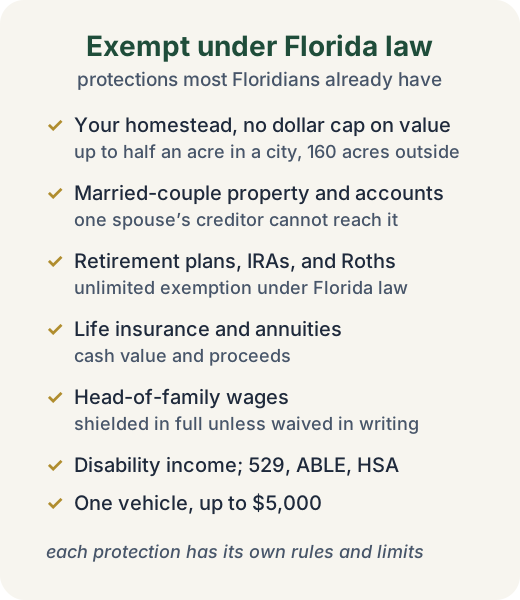
Florida’s constitutional homestead exemption protects your primary residence from forced sale by most creditors, with no dollar limit on value, up to half an acre inside a municipality or 160 acres outside one. It is self-executing and passes its protection to a surviving spouse and heirs.
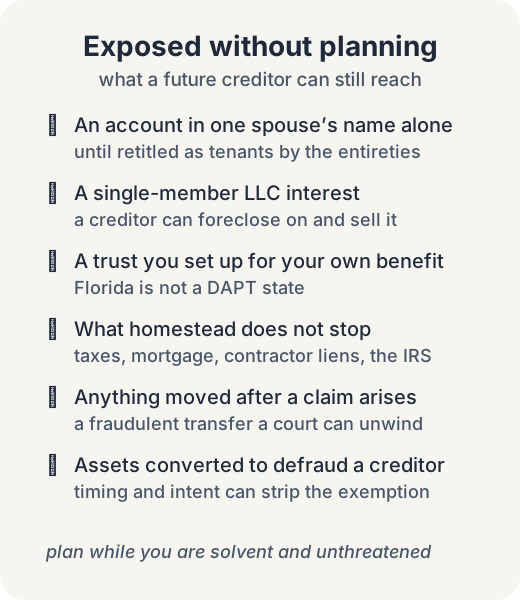
Know the limits. Homestead does not stop property taxes and assessments, a purchase-money or improvement mortgage, or construction liens. It also does not stop the IRS or a consensual mortgage you sign. In bankruptcy, equity in a home bought within about 40 months of filing is capped (the current cap is $214,000). Used correctly, the homestead is the strongest single shield Florida offers. How far the homestead shields you from creditors → · pass it without probate →
Tenancy by the Entireties: The Married-Couple Shield
Property a married couple holds jointly is presumed to be tenancy by the entireties (TBE), and that includes bank and brokerage accounts, not just real estate. A creditor of one spouse cannot reach TBE property. It is automatic and free, but it has limits. It does not stop the couple’s joint creditors. It does not beat a federal tax lien. It ends at divorce or the first spouse’s death. It protects two living spouses; it is not an estate plan.
Florida’s Statutory Exemptions (Chapter 222)
Beyond the homestead, Florida shields a deep menu of assets from creditors:
- Retirement accounts and IRAs: unlimited exemption for qualified plans, IRAs, and Roths. Florida protects inherited IRAs too, but federal bankruptcy law does not, so an heir living outside Florida can lose that protection.
- Head-of-family wages: if you cover most of the support for a child or another dependent, Florida keeps your paycheck out of a creditor’s reach no matter its size. A $900-a-week paycheck and a $9,000-a-week paycheck are shielded the same way, unless you have signed that protection away in writing. Once the money lands in your bank account it holds that shield for another six months, as long as it can be traced.
- Life insurance and annuities: cash value and proceeds are exempt from the owner’s creditors. Note that creditor-exempt is not the same as Medicaid-exempt.
- Disability income and 529, ABLE, and health-savings accounts.
- Motor vehicle: up to $5,000 in one vehicle, plus a $4,000 wildcard if you do not claim the homestead exemption.
One guardrail: converting non-exempt assets into exempt ones with intent to defraud a creditor can strip the exemption. Timing and intent matter.
LLCs and the Charging Order: the Single-Member Trap
A creditor of an LLC member is normally limited to a charging order (a lien on distributions). They cannot seize the membership interest or run the company. But that protection does not apply to a single-member LLC. The Florida Supreme Court has held that a creditor can foreclose on and sell a single-member interest. Never rely on a single-member LLC for protection. Add a genuine second member, or use a limited partnership or LLLP, which keeps the charging order as the exclusive remedy with no single-member exception.
Florida Is Not a “DAPT” State (the Clarification People Search For)
Florida has no domestic asset-protection-trust statute. A self-settled trust, where you create the trust and stay a beneficiary, gives you no protection from your own creditors here. Under Florida law, a creditor can reach whatever the trustee could distribute to you. Buying a Nevada or Delaware “asset-protection trust” online usually will not save a Florida resident either, because whether the funding transfer can be undone is judged under Florida’s fraudulent-transfer law, not the trust’s chosen state.
A properly drafted trust for someone else you provide for (a spendthrift trust) can protect that beneficiary well. The one real self-settled exception is the inter-spousal carve-out for certain spousal trusts, expanded in 2022 to cover lifetime SLATs. What asset protection trusts actually work in Florida → · do you need an offshore trust? →
Deep dives on the exemptions and tools above: retirement accounts (401k and IRA) · annuities and life insurance · LLCs and charging orders · the physician playbook · already being sued? the honest answer
Swipe the table sideways to see every tool and its limits.
| Tool | What it protects | Key limit |
|---|---|---|
| Homestead | Your home, unlimited value | Taxes, mortgage, mechanic’s liens, IRS; bankruptcy equity cap |
| Tenancy by entireties | Married-couple property + accounts | Joint creditors, IRS; ends at divorce/death |
| Retirement / IRA | Qualified plans, IRAs, Roths | Inherited IRA not protected in federal bankruptcy |
| Multi-member LLC / LLLP | Business + rental assets | Single-member LLC can be foreclosed (Olmstead) |
| Spendthrift trust | A beneficiary you provide for | Not your own assets; support creditors can reach |
The Rule on Top of Every Rule: Fraudulent Transfers
You cannot shield assets from a creditor whose claim already exists or is reasonably foreseeable. Under Florida’s fraudulent-transfer law, a transfer can be voided for actual fraud (shown by circumstances of intent), constructive fraud (giving away value while insolvent), or insider preferences, with a four-year reach-back. Courts have treated even meeting an asset-protection lawyer after a claim arose as a circumstance of intent. Plan while you are solvent and unthreatened, and document it.
The Medicaid and Relocation Crossovers
Long-term-care planning is a separate discipline. A Medicaid asset-protection trust is irrevocable and must be funded at least five years before you need nursing-home care. A creditor-exempt annuity can still be a Medicaid problem, and the homestead, though generally Medicaid-exempt, is exposed to estate recovery. See Medicaid planning and the home →
Separately, establishing Florida domicile is itself an upgrade: a married couple gains tenancy by the entireties and the unlimited homestead, but only once they are genuinely Floridians.
Protect it before you need to.
A free 30-minute consult maps the exemptions you already have and the structure that fits your risk.
Book your free consultFrequently Asked Questions
Is My Home Protected From Creditors in Florida?
Yes. Florida’s constitutional homestead exemption protects your primary residence from most creditors with no dollar limit, up to half an acre in a city or 160 acres outside one. The main exceptions are property taxes, your mortgage, and contractor (mechanic’s) liens, and it does not stop the IRS. If you bought recently and later file bankruptcy, a federal rule can cap the protected equity.
Is Florida a Tenancy-by-the-Entireties State?
Yes. Married couples can own property, real estate and even bank and brokerage accounts, as tenants by the entireties, which shields it from a creditor of just one spouse. It does not protect against debts the couple owes jointly, it does not beat the IRS, and it ends at divorce or the first spouse’s death.
Are My IRA and 401(k) Protected From Creditors in Florida?
Yes. Florida gives an unlimited exemption to IRS-qualified retirement plans, IRAs, and Roth IRAs (§222.21). Florida even protects inherited IRAs, but federal bankruptcy law does not, so an heir who lives outside Florida may lose that protection.
What Is a Florida Asset Protection Trust, and Does Florida Allow One?
Florida does not have a domestic asset-protection-trust statute. A trust you create for your own benefit gives you no protection from your own creditors here (§736.0505), and an out-of-state DAPT usually won’t save a Florida resident either. Real protection for Floridians comes from exemptions, ownership form, multi-member entities, and trusts you set up for other people you provide for.
Can I Move My Assets After I’ve Been Sued?
No. Once a claim exists or is foreseeable, moving assets is a fraudulent transfer a court can unwind (Ch. 726), and it can create ethics and bankruptcy problems. Asset protection only works when it’s done before trouble, while you’re solvent and unthreatened.
Is a Single-Member LLC Good Asset Protection in Florida?
Generally no. The Florida Supreme Court held in Olmstead (2010) that a creditor can foreclose on and sell a single-member LLC interest. A multi-member LLC, or a limited partnership/LLLP, keeps a creditor limited to a charging order. If you rely on an LLC for protection, it needs a genuine second member.
What Assets Are Exempt From Creditors in Florida?
Beyond the homestead: retirement accounts and IRAs, the cash value and proceeds of life insurance and annuities, the paycheck of a head of family who supports a dependent (shielded in full unless waived in writing), disability income, 529/ABLE/health-savings accounts, and a vehicle up to $5,000. Each has its own rules and limits.
Will an Asset Protection Trust Help Me Qualify for Medicaid?
That’s a different tool. A Medicaid asset-protection trust must be irrevocable and funded at least five years before you need nursing-home care, because of Medicaid’s five-year look-back. It overlaps with creditor protection but follows separate rules.
Does Asset Protection Mean I Don’t Have to Pay My Debts?
No. Legitimate asset protection reduces your exposure to future unknown claims using exemptions Florida law already gives you. It is not a way to dodge debts you already owe or claims you can see coming; courts unwind those.
I’m a Physician or Business Owner, What Should I Do First?
Plan before any claim, while you’re solvent. Typically: confirm your homestead and retirement protections, title married-couple assets as tenants by the entireties, hold rental and business assets in properly structured multi-member entities, and layer trusts where they fit, all documented. Start with a consult.
Can Creditors Garnish My Wages in Florida?
Often not, if you are the head of your family. Under Florida law, if you provide more than half the support of a child or other dependent, your disposable wages are fully protected from garnishment up to $750 a week, and even the part above $750 can be garnished only if you agreed to it in writing, a trap buried in some loan and credit paperwork. If you are not the head of a family, the federal rule applies and a creditor can reach up to 25%. Protected wages you deposit in a bank stay protected for six months if they can be traced. Child support and certain taxes follow different rules.
Common Situations
The physician. An OB/GYN with a paid-off Coral Gables home, a $1.4M 401(k), and a $600K brokerage account worries about a claim beyond her coverage. Before any incident: the home is already homestead-protected, the 401(k) is exempt under Florida law, and re-titling the brokerage account with her husband as tenants by the entireties shields it from a creditor of hers alone. No exotic trusts, just Florida’s own exemptions, used in time.
The landlord. A contractor owns four rentals through one single-member LLC and personally guaranteed a credit line. A tenant’s injury suit could pierce straight to the membership interest under Olmstead. The fix is structural and pre-claim: separate the properties and bring real co-members or an LLLP into the ownership, before a suit arrives.
The new Floridian. A New Jersey couple retires to Naples. Establishing Florida domicile upgrades them automatically: unlimited homestead, tenancy by the entireties, no state income tax. But the upgrade only applies once they are genuinely Floridians, and their out-of-state will and trust have to be re-executed under Florida law.
Sources of Law
- Homestead: Fla. Const. Art. X §4; Havoco v. Hill, 790 So. 2d 1018 (Fla. 2001); bankruptcy cap 11 U.S.C. §522(p). TBE: Beal Bank v. Almand, 780 So. 2d 45 (Fla. 2001); United States v. Craft, 535 U.S. 274 (2002).
- Exemptions: Fla. Stat. §222.11, §§222.13 to 222.14, §222.18, §222.21, §222.22, §222.25, §§222.29 to 222.30; Clark v. Rameker, 573 U.S. 122 (2014). Entities: Olmstead v. FTC, 44 So. 3d 76 (Fla. 2010); §605.0503, §620.1703. Trusts: §736.0502, §736.0505. Fraudulent transfers: Ch. 726 (FUFTA), §222.30. (retrieved 2026-06-06)
Updated July 11, 2026. Reviewed by Kevin D. Klagge, Esq., Fla. Bar No. 99502. Attorney Kevin Klagge represents families, businesses, and international clients in estate planning and international law, with a focus on Florida legal tools. He litigates estate and business issues in court. General information about Florida law, not legal advice, and no attorney-client relationship is created. Asset protection reduces risk using lawful exemptions; it is not a guarantee that creditors can never reach assets, and it must be done before a claim arises. Outcomes depend on your specific facts.