
The Short Answer
This worry keeps a lot of Florida families up at night, so let us put it plainly. A nursing home does not take your house; it is paid for the care it provides. What people really mean is Medicaid, the program that pays for most long-term care, and Medicaid cannot take your home while you are alive. Your house is protected the entire time you need care. The only real risk is after death, and it reaches only your home if you leave it exposed. Set it up to pass the right way and the home stays in the family.
While You Are Alive, Your Home Is Safe
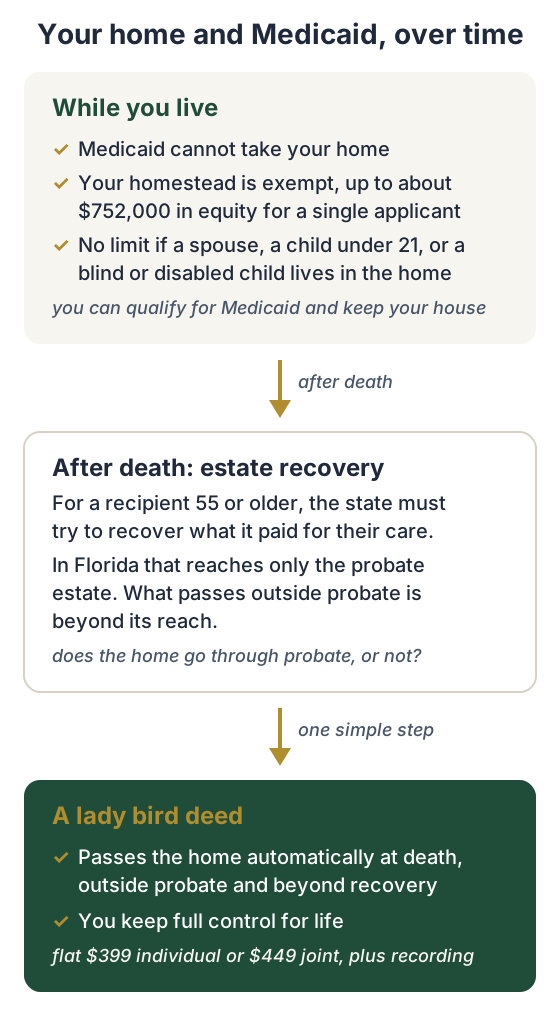
In Florida, your homestead is an exempt asset for Medicaid while you live there or intend to return. For a single applicant in 2026 that protection runs up to a home-equity limit of about $752,000, and there is no limit at all if your spouse, or a child under 21 or a blind or disabled child, lives in the home. In plain terms: you can qualify for Medicaid, move into care, and still own your house. Nobody makes you sell it to pay for your lifetime care.
The Real Risk Comes After Death
Here is the part that catches families off guard. When a Medicaid recipient who was 55 or older dies, the state is required to try to recover what it paid for their care. This is called estate recovery. In Florida, recovery reaches only the probate estate, meaning the assets that pass through the probate court after death. Anything that passes outside probate is beyond its reach. So the whole question of whether your family keeps the home comes down to one thing: does the home go through probate, or not?
How to Keep the House in the Family
Because estate recovery only touches the probate estate, the fix is to make sure the home passes outside probate. The tools, from simplest to most involved:
- A lady bird deed. The most common and affordable answer. It passes your home automatically to the people you choose at death, outside probate and beyond estate recovery, while you keep full control for life. You can still sell or change your mind. See how it works →
- Tenancy by the entirety for married couples, which keeps the home protected while a spouse survives.
- A Medicaid asset protection trust, an irrevocable trust that shields the home and savings, for families who plan at least five years ahead. More on that here →
What About a Second Home or Rental Property?
Everything above is about your homestead, your primary Florida home, which gets special protection. A second home, vacation home, or rental property is treated very differently, and this is where people are caught off guard. A non-homestead property is a countable asset, which means its value can stand directly between you and Medicaid eligibility, and it is fully exposed to estate recovery if it passes through probate. In other words, the second home is often the property most at risk, not the one you live in.
There are good options, and the right one depends on your timing and goals:
- Rent it at a fair price. Florida treats a property that earns reasonable rent as "income-producing," and disregards its entire value for eligibility (with no cap), even if it is only rented seasonally. The catch is that the rent itself counts as income. This is often the simplest fix for a rental or a vacation home you can lease out.
- Plan ahead with a Medicaid asset protection trust. An irrevocable trust can take the second home out of your countable assets entirely and out of probate, protecting it from both the spend-down and estate recovery, as long as it is set up at least five years before you need care.
- A lady bird deed keeps the property out of probate, so it escapes estate recovery at death, but it does not make it exempt while you are alive. It is often one piece of a larger plan for a second home, not the whole answer.
Here is the homestead and the second home side by side:
| Your homestead | A second home or rental |
|---|---|
| Exempt while you live there or intend to return | A countable asset; its value can stand between you and eligibility |
| After death, estate recovery can reach it only if it passes through probate | Fully exposed to estate recovery if it passes through probate |
| Protect it with a lady bird deed, tenancy by the entirety (married couples), or a Medicaid asset protection trust | Rent it at a fair price (the rent counts as income), plan five years ahead with a Medicaid asset protection trust, or use a lady bird deed (out of probate, but not exempt while you live) |
The takeaway: your homestead is largely safe, but a second property needs a deliberate plan. We will tell you which approach fits yours.
What Not to Do: Give the House Away
The instinct to simply deed the home to the kids is the costliest mistake we see. A gift of your home is a transfer that can trigger a five-year Medicaid penalty, leaving you unable to qualify when you need care. It also throws away the tax step-up, which can cost your children a large capital-gains bill when they sell, and it exposes the home to their creditors and divorces. A lady bird deed reaches the same goal, the home out of probate and beyond recovery, with none of that damage. Talk to us before you transfer anything, and see what a gift would trigger on the Medicaid penalty calculator.
Worried about the house and a parent who needs care?
Book a free 30-minute consult. We will tell you exactly how to keep the home safe, whether that is a simple deed or a full plan, before you spend a dollar.
Book your free consultWhat It Costs to Protect the Home
For most families the answer is a lady bird deed, a flat $399 individual or $449 joint, plus county recording. A larger Medicaid asset-protection plan that also shields savings is quoted at the consult, since the numbers differ for every family. Either way the consult is free, and we will point you to the lightest tool that does the job. See Medicaid planning → or check eligibility →
Frequently Asked Questions
Can a Nursing Home Take Your House in Florida?
No. A nursing home is paid for care; it does not seize your home. What people are really worried about is Medicaid, the program that pays for most long-term nursing care. While you are alive, your Florida home is protected and Medicaid cannot take it. The only real risk comes after death, through a process called estate recovery, and even that reaches only certain assets. With a little planning, the home stays in the family.
Will Medicaid Take My Home While I Am Alive?
No. Your Florida homestead is an exempt asset while you live there or intend to return, up to a 2026 home-equity limit of $752,000 for a single applicant (and there is no limit at all if your spouse, or a child under 21 or a blind or disabled child, lives in the home). You can qualify for Medicaid and keep living in your house. The home is not sold to pay for your care during your lifetime.
What Is Medicaid Estate Recovery?
After a Medicaid recipient who was 55 or older dies, federal law requires the state to try to recover what it spent on their long-term care. In Florida, that recovery reaches only the "probate estate," meaning assets that pass through the probate court. Anything that passes outside probate is beyond its reach. That single fact is the key to protecting your home, because a home can be set up to pass outside probate.
How Do I Protect My House From Medicaid Estate Recovery?
The simplest tool for most Florida families is a lady bird deed, which passes your home automatically to your children at death, outside probate, so estate recovery cannot touch it, while you keep full control during your life. Married couples who own the home together as tenants by the entirety also have protection. For larger plans that protect savings as well as the home, an irrevocable Medicaid asset protection trust can work if set up at least five years ahead. We will tell you which one fits.
Should I Just Give My House to My Kids to Protect It?
Please talk to us before you do that, because it usually backfires. Giving your home away is a transfer that can trigger a five-year Medicaid penalty, leaving you unable to qualify for care when you need it. It also strips the tax step-up, which can cost your children tens of thousands in capital-gains tax when they sell, and exposes the home to their creditors and divorces. A lady bird deed reaches the same goal without any of that.
What if My Spouse Still Lives in the House?
Then it is doubly protected. The home is exempt while your spouse lives there, with no equity limit, and Florida cannot pursue estate recovery while a surviving spouse is alive. When one spouse needs nursing care and the other stays home, Florida’s spousal protections are designed to keep the well spouse in the house and financially secure. This is exactly the situation Medicaid planning handles well.
What About My Second Home, Vacation Home, or Rental Property?
A second home is treated very differently from your primary homestead, and it is usually the property most at risk. Unlike your homestead, a non-homestead property is a countable asset, so its value can keep you from qualifying for Medicaid, and it is fully exposed to estate recovery if it passes through probate. The good news is there are options: renting it at fair value makes it "income-producing," which Florida disregards for eligibility (with no cap, even if rented only seasonally), though the rent counts as income; an irrevocable Medicaid asset protection trust can remove it from countable assets and probate if set up five years ahead; and a lady bird deed at least keeps it out of probate and beyond recovery at death. We sort out the right approach at the consult.
Is My House Safe if I Have Not Done Any Planning?
It is exempt while you are alive, but without planning it will likely pass through probate at your death, which is precisely where estate recovery can reach it. The good news is that it is rarely too late: a lady bird deed can often be recorded even after a parent has entered care (because it is not a gift), keeping the home out of probate and beyond recovery. Sooner is always safer, but a quick consult is worth it at any stage.
How Much Does It Cost to Protect the Home?
A lady bird deed, the most common tool, is a flat $399 for an individual or $449 for a joint deed, plus county recording. A full Medicaid asset-protection plan that shields savings as well is quoted at the consult, because every family’s numbers differ. The 30-minute consult itself is free, and we will tell you honestly whether you need the simple deed or the larger plan.
Common Situations
The daughter who feared the worst. Her father needed nursing care and she was sure the home would be lost. We explained the home was exempt while he lived, recorded a lady bird deed so it would pass to her outside probate, and qualified him for Medicaid. The house stayed in the family, and estate recovery never reached it.
The couple, one spouse in care. A husband entered a nursing home; his wife stayed in their Naples home. Because she still lived there, the home was fully protected, and Florida’s spousal rules let her keep the house and a meaningful share of their savings. The fear of losing the home was never founded.
The "I already gave it to my son" call. A widow deeded her home to her son to "protect" it, then applied for Medicaid six months later and was hit with a penalty. Had she called first, a lady bird deed would have protected the home with no penalty and no tax cost. We help families avoid this exact mistake.
Sources of Law
- Fla. Stat. §409.9101: Florida Medicaid estate recovery, limited to the probate estate. flsenate.gov (retrieved 2026-07-11)
- Federal Medicaid rules: 42 U.S.C. §1396p (estate recovery for recipients 55+, the homestead exemption while residing, and the five-year transfer look-back).
- 2026 Florida ICP home-equity limit (about $752,000, single applicant; no limit with a spouse or a child under 21 or a blind or disabled child in the home). Lady bird (enhanced life estate) deeds are recognized by Florida common law and title practice.
Updated on July 11, 2026. Reviewed by Kevin D. Klagge, Esq., Fla. Bar No. 99502. Attorney Kevin Klagge represents families, businesses, and international clients in estate planning and international law, with a focus on Florida legal tools. He litigates estate and business issues in court. General information about Florida law and 2026 Medicaid figures, not legal advice; figures change annually and eligibility turns on your specific facts. No attorney-client relationship is created. Do not send confidential information until we have agreed to represent you.