
The Short Answer
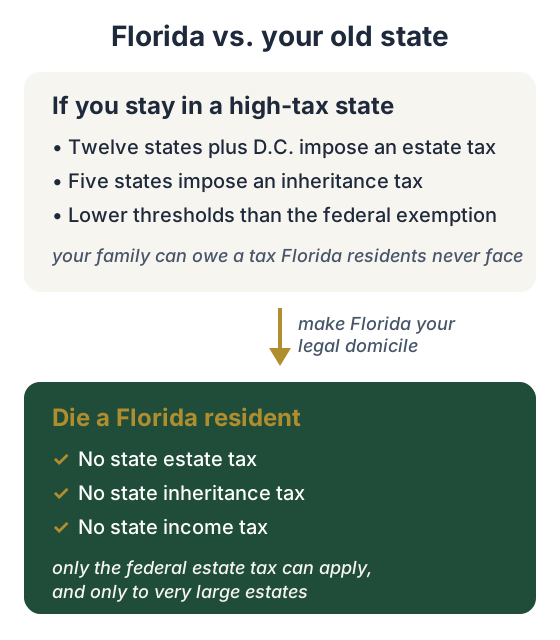
Florida charges no estate tax, no inheritance tax, and no income tax. When you die a Florida resident, the only death tax that can reach you is the federal estate tax, and that applies only to very large estates (about $15 million per person in 2026). For almost everyone, that means no death tax at all. The catch, and the reason this page exists, is that the state you are leaving may tax estates at a far lower threshold than the federal one.
The States That Still Tax Your Estate
Florida is in the comfortable majority. But if you live in, or own property in, one of these states, your family can owe a tax Florida residents never face:
Swipe the table sideways to see each state’s catch.
| State | Type | The catch |
|---|---|---|
| Massachusetts | Estate | Taxes estates over $2M, not portable between spouses |
| Oregon | Estate | Starts at just $1M |
| New York | Estate | A "cliff" that can tax the entire estate, not just the excess |
| Washington | Estate | Starts at $3M; rates reach 20% even after its mid-2026 rate cut |
| Illinois, HI, ME, MN, RI, VT | Estate | Lower thresholds than the federal exemption (Illinois $4M; Connecticut now matches the federal amount) |
| New Jersey, Pennsylvania, Kentucky, Nebraska | Inheritance | Tax the people who inherit, sometimes even modest amounts |
| Maryland | Both | The only state with an estate tax and an inheritance tax |
Thresholds and rules change; we confirm the current figures for your state at the consult.
Plan to the State Number, Not the Federal One
Here is the mistake that costs families the most. The federal exemption is so high (about $15 million per person) that advisors routinely tell clients they have nothing to worry about. Federally, true. But a family worth $3 million is completely clear of federal tax and squarely in their home state’s crosshairs. Massachusetts would tax that estate; so would Oregon, and others. If you plan only to the federal number, you can walk straight into a state estate-tax bill nobody warned you about.
How Florida Saves It: Change Your Domicile
If you make Florida your legal domicile before you die, your estate is generally governed by Florida law, which has no estate tax, rather than your old state’s. For a high-tax-state family, that shift can save hundreds of thousands of dollars. The move has to be real, though, because states like New York run aggressive domicile audits, and buying a Florida condo is not enough. You establish Florida as your true home and document it: a recorded Declaration of Domicile, a Florida license and voter registration, the homestead exemption, an estate plan redone under Florida law, and a day-count that clearly favors Florida. We prepare the documents and give you the checklist.
Moving to Florida from a state that taxes estates?
Book a free 30-minute consult. We will map the domicile move and the plan that locks in Florida’s no-tax advantage, working with your home-state counsel where needed.
Book your free consultTwo Traps, and the Tools
The out-of-state property trap: real estate you keep in another estate-tax state can still be taxed by that state, because real property is taxed where it sits. A Florida retiree with a vacation home in Maine or Massachusetts can still owe that state’s estate tax on it, often fixed by holding the property in an entity or trust. Run your own numbers on the state estate tax calculator. If you cannot move, certain irrevocable trusts and lifetime gifting can still trim a taxable estate in your home state. And for married couples generally, estate tax portability preserves a deceased spouse’s federal exemption, while a community property trust and other irrevocable trusts address the tax on appreciated assets. We match the tools to your state and your goals.
Frequently Asked Questions
Does Florida Have an Estate Tax or Inheritance Tax?
No. Florida has no state estate tax and no state inheritance tax, and no state income tax either. When someone dies as a Florida resident, the only death tax that can apply is the federal estate tax, and that hits only very large estates (about $15 million per person in 2026). For the vast majority of Florida families, there is no death tax at all. This is one of the real financial reasons people make Florida their permanent home.
Which States Still Have an Estate or Inheritance Tax?
As of 2026, twelve states plus Washington, D.C. impose an estate tax (Connecticut, Hawaii, Illinois, Maine, Maryland, Massachusetts, Minnesota, New York, Oregon, Rhode Island, Vermont, and Washington), and five states impose an inheritance tax (Kentucky, Maryland, Nebraska, New Jersey, and Pennsylvania; Iowa repealed its tax for deaths after 2024). Maryland is the only state with both. If you live in or own property in one of these states, your family can owe a tax that Florida residents never face.
Why Does the Federal Exemption Hide the Real Problem?
Because the federal estate-tax exemption is so high (about $15 million per person in 2026) that most advisors tell clients they have "nothing to worry about." That is true federally, but it can be dangerously misleading, because many states tax estates at a far lower threshold. Massachusetts taxes estates over $2 million; Oregon starts at $1 million. A family worth $3 million is completely clear of federal tax and squarely in their home state’s crosshairs. You have to plan to the state number, not the federal one.
How Does Moving to Florida Save Estate Tax?
If you change your legal domicile to Florida before you die, your estate is generally governed by Florida law, which has no estate tax, instead of your former state’s. For a family in a high-tax state, that shift can save hundreds of thousands of dollars. The move has to be real, though: high-tax states like New York run aggressive "domicile audits," so buying a Florida condo is not enough. You establish Florida as your true home and document it. We handle the legal side of that move.
If I Move to Florida, Is My Whole Estate Safe?
Almost, but watch one trap: real estate you keep in another state that has an estate tax can still be taxed by that state, because real property is taxed where it sits, not where you live. A Florida retiree who keeps a vacation home in Maine or Massachusetts can still owe that state’s estate tax on that home. The fix is usually to change how that out-of-state property is owned, often by placing it in an entity or trust, which we plan as part of the move.
What Does It Take to Establish Florida Domicile?
A genuine relocation, backed by paperwork: a recorded Declaration of Domicile, a Florida driver license and voter registration, filing for the Florida homestead exemption, updating your estate plan under Florida law, spending the majority of your time here, and cutting ties to the old state (especially the day-count, since high-tax states count your days). No single step does it; the pattern does. We give you the checklist and prepare the documents.
I Can’t Move. Can I Still Reduce My State Estate Tax?
Sometimes, yes. Even for someone who stays in a high-tax state, certain irrevocable trusts and lifetime-gifting strategies can reduce the taxable estate, and a married couple can use planning to make the most of both spouses’ state exemptions. These are more involved and depend on your state’s specific rules, so they call for coordination with counsel in your home state, which we are glad to do.
Does Florida Have a Gift Tax?
No. Florida has no gift tax either. The only gift tax is federal, and most people never owe it because of the annual exclusion ($19,000 per recipient in 2026) and the $15 million lifetime exemption. So a Florida resident planning lifetime gifts is dealing only with federal rules, not a state layer on top.
Common Situations
The Boston couple worth $3 million. Their advisor said they were "under the exemption," meaning the federal one. They were not under the Massachusetts $2 million threshold, and their estate faced a six-figure state tax. Establishing Florida domicile, with the paperwork to back it up, removed the Massachusetts bill entirely.
The New York snowbird audited. A retiree spent winters in Naples but kept a New York apartment and most of his life up north. New York treated him as still domiciled there. We built a clean domicile record (days, license, declaration, plan redone under Florida law) so the next time the question came up, the answer was clearly Florida.
The Maine vacation home. A Florida couple thought they were fully clear, but their Maine cottage exposed them to Maine estate tax on that property. Restructuring how the cottage was owned solved it.
Sources of Law
- Florida imposes no state estate, inheritance, or income tax (Fla. Const. Art. VII). The federal estate and gift tax exemption is $15,000,000 per person in 2026 (IRC §2010, One Big Beautiful Bill Act). (retrieved 2026-06-07)
- State estate and inheritance taxes are set by each state’s own law and change frequently; thresholds (e.g., Massachusetts $2M, Oregon $1M, New York’s cliff) are confirmed at the consult.
- Florida domicile: Fla. Stat. §222.17 (Declaration of Domicile). Real property is generally subject to estate tax in the state where it is located.
Updated on July 11, 2026. Reviewed by Kevin D. Klagge, Esq., Fla. Bar No. 99502. Attorney Kevin Klagge represents families, businesses, and international clients in estate planning and international law, with a focus on Florida legal tools. He litigates estate and business issues in court. General information about Florida and federal law, not legal or tax advice, and no attorney-client relationship is created. State tax rules and figures change; outcomes depend on your facts and on coordinating with your home-state counsel. Do not send confidential information until we have agreed to represent you.