What Does a Florida Prenuptial Agreement Do?
A prenuptial agreement is a contract two people sign before they marry. Florida’s premarital agreement act calls it a premarital agreement. The contract takes effect the moment the marriage becomes valid, and no other consideration is needed beyond the marriage itself. The agreement must be in writing and signed by both parties.
Property under the act is defined broadly. Property includes any interest, present or future, legal or equitable, vested or contingent, in real or personal property. Property includes tangible and intangible assets, income and earnings, both active and passive. A business interest and a retirement account fall within the definition.
The agreement replaces Florida’s default rules on two fronts. On the divorce side, Florida starts from a presumption that anything acquired during the marriage is marital property and should be divided equally. Without an agreement, a court looks first at what is marital and what is nonmarital, then divides the marital pot. Enhancement in value from either spouse’s work or from marital funds, principal paydown on a premarital home using marital income, and retirement benefits accrued during the marriage all count as marital. An agreement can change every one of those rules by defining what stays separate.
On the death side, a surviving spouse has statutory rights that override most estate plans. The elective share gives a surviving spouse roughly 30 percent of the elective estate (the portion of the decedent’s wealth a surviving spouse can claim whatever the will says). The elective estate reaches far beyond probate. Revocable trust assets, pay-on-death accounts, survivorship accounts, life insurance cash value and retirement death benefits all fall within the calculation. A spouse married after the will was signed takes an intestate share unless the will or an agreement provides otherwise. A surviving spouse cannot be cut out of homestead unless the spouse waives that right in writing.
A prenup lets the couple decide these questions themselves, while they agree, rather than leave them to a judge or to statutes written for the general case.
Is Florida a Community Property State? What Happens Without a Prenup
Florida is an equitable distribution state. A Florida court first sets aside each spouse’s nonmarital property, then divides the marital property, starting from an equal split but departing from equal on a list of factors including the length of the marriage, each spouse’s contributions and any dissipation of assets.
Nonmarital property includes what each spouse owned before the wedding, what each receives by gift or inheritance during the marriage, and income from nonmarital property unless the couple treated it as marital. Almost everything else acquired after the wedding is presumed marital. Real property held by the spouses as tenants by the entireties is presumed marital whether it was acquired before or during the marriage. Enhancement in value from either spouse’s effort, mortgage paydown on a premarital home from marital funds, and retirement benefits accrued during the marriage are marital unless an agreement says otherwise.
At a death the defaults are just as detailed. A spouse who survives an intestate decedent takes the whole estate if the decedent left no descendants, or half if either spouse has a descendant who is not the other’s. The elective share is 30 percent of the elective estate with deadlines of 6 months from service of the notice of administration or 2 years from the death, whichever is earlier. A surviving spouse takes a life estate in the homestead with the remainder passing to descendants, or may elect a one-half interest instead within 6 months. Exempt property includes up to $20,000 of household furnishings and two motor vehicles. The family allowance is up to $18,000. A pretermitted spouse married after the will takes an intestate share unless the agreement provides otherwise.
| Without a prenup | With a Florida prenup |
|---|---|
| Marital property divided by a court, starting from equal | Property divided as the agreement says |
| Enhancement and retirement accrual presumed marital | Each can be kept separate or shared as agreed |
| Surviving spouse takes 30 percent elective share | Elective share waived by the agreement |
| Surviving spouse takes homestead life estate or half | Homestead rights waived, estate passes as the will says |
| Family allowance and exempt property go to the survivor | Waived, available to the estate |
What Can a Florida Prenup Cover, and What Can It Not?
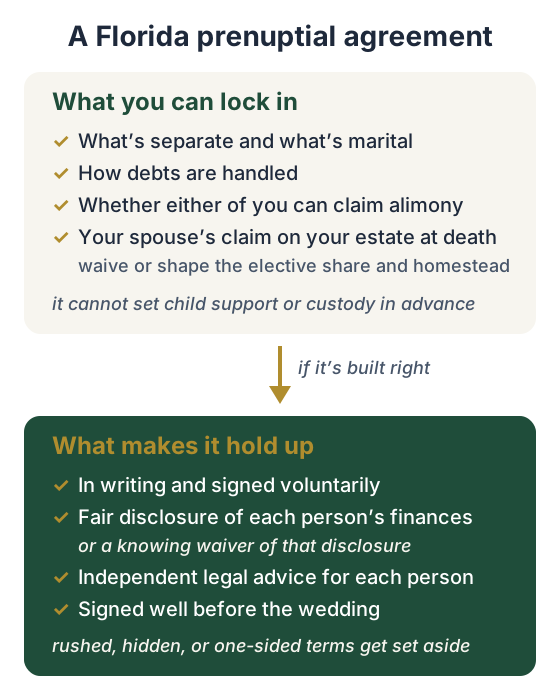
Florida’s premarital agreement act lists the subjects the parties may include. The list is broad. A prenup may address the rights and obligations of each party in any property of either or both, whenever and wherever acquired. The agreement may cover the right to buy, sell, transfer, mortgage, manage or otherwise control property. The same agreement may govern what happens to property on separation, divorce, death or any other event. The couple may establish, modify, waive or eliminate spousal support. The agreement may require each party to make a will, a trust or another arrangement to carry out its terms. Life insurance death benefits may be assigned in it. The couple may select the law that governs the agreement. Any other matter that is not against Florida public policy or criminal law may go in as well.
Spousal support under current Florida law takes the form of temporary, bridge-the-gap, rehabilitative or durational alimony. Bridge-the-gap is limited to 2 years. Rehabilitative alimony is limited to 5 years. Durational alimony is capped at 50, 60 or 75 percent of the marriage’s length and at 35 percent of the difference between the spouses’ incomes. Permanent alimony was eliminated for divorce petitions filed on or after July 1, 2023. A prenup may waive each form by name.
A prenup cannot adversely affect a child’s right to support. Child support, parental responsibility and time-sharing are decided by the court according to the child’s best interests, not by contract.
A prenup cannot waive temporary support or temporary attorney’s fees during a pending divorce case under current Florida law. Whatever the agreement says, a court may award temporary relief while the case is open.
A prenup’s waiver of spousal support is subject to one override. If the modification or elimination of support would cause one spouse to be eligible for public assistance at the time of separation or divorce, a court may order the other spouse to provide enough support to avoid that eligibility, regardless of what the agreement says.
A prenup binds the two spouses and does not bind a bank, a lender or any other creditor. A joint debt remains collectible from both spouses no matter what the agreement says between them. The agreement’s indemnity is the private settlement of who bears the loss as between the spouses, and each spouse can enforce it against the other, but a creditor can collect from either.
What Clauses Does a Florida Prenup Contain?
The firm’s form runs about 40 articles. The opening recitals name each party, note any prior marriages and children, describe each party’s work and expected income, state why the agreement exists, and confirm that each party would sign regardless of the other’s wealth. A separate article restates, in the language of Florida’s premarital agreement act, that each party signed voluntarily, that the agreement is not the product of fraud, duress, coercion or overreaching, that it is fair and reasonable at signing, that each party received fair disclosure, that each expressly waives further disclosure in writing, and that each has adequate knowledge of the other’s finances.
Each party’s disclosure appears on an attached exhibit listing income, assets, debts and any estate interest, with an acknowledgment that the values are good-faith approximations. An express written waiver of further disclosure follows. The property articles define separate property broadly (everything owned at the marriage, everything acquired in one name, all appreciation whether active or passive, all income and earnings, business interests, retirement accounts, gifts, inheritances, personal injury recoveries, professional licenses and goodwill, and anything not titled jointly). An optional shared-growth clause provides that growth in premarital or inherited property during the marriage is shared equally at a divorce, with starting values documented within 60 days after the wedding. The agreement limits marital property to jointly titled property, joint accounts, and any business either party starts during the marriage. A repayment clause returns each party’s separate contribution to a joint purchase before an equal split.
The debt articles keep separate debts separate with an indemnity and define marital debts as joint debts only. The death-side articles waive the elective share, the intestate share, the pretermitted share, homestead (including devise and descent rules), exempt property, the family allowance, community property rights, any right to take against the other’s will or trust, and any right to serve as personal representative unless named. A six-month residence right lets the survivor stay in a home that was the decedent’s separate property while the estate pays mortgage, taxes and insurance and the survivor pays utilities. A covenant not to contest the other’s will or trust follows.
The divorce-side articles define the marriage termination event (the first of a served petition, a signed settlement, or written notice of intent to separate), waive every form of alimony by name (bridge-the-gap, rehabilitative, durational, lump sum, permanent under any prior or future law), and waive modification. Retirement accounts stay separate, with an election to waive survivor annuity rights and a covenant to sign the plan’s own spousal consent forms within 30 days after the wedding. Remaining articles cover joint tax returns with proportional shares, moves to a community property state, trust interests, estate planning freedom, real property outside the United States, language (where one party’s first language is not English), immigration (including that the agreement is independent of any I-864 affidavit of support), amendment only by a signed writing, severability, Florida law as of the signing date, a reaffirmation within 90 days after the wedding, voluntary-execution recitals, and a prevailing-party attorney’s fee clause. Each party signs before two witnesses and a notary, and each party’s lawyer signs a certification.
What Does a Prenup Do at Death? The Estate Side Most Couples Miss
A surviving spouse who never signed an agreement has a set of rights under Florida law. The intestate share is the whole estate or one half, depending on children. The elective share is 30 percent of the elective estate, which reaches beyond probate to include revocable trust assets, pay-on-death accounts, survivorship accounts, life insurance cash value, retirement death benefits and certain transfers made within a year of death. When a decedent leaves descendants, the homestead passes to the spouse as a life estate (with a remainder to descendants) or as an undivided one-half interest if the spouse elects within six months. Exempt property means up to $20,000 of furnishings plus two vehicles. The family allowance is up to $18,000. A spouse married after the will takes an intestate share unless the agreement provided for or waived that right.
A written agreement signed before two subscribing witnesses can waive every one of these rights. A waiver of “all rights” in the other spouse’s property renounces each right even if the agreement never mentions death. The Florida Supreme Court held in 1991 that a spouse’s premarital waiver of homestead rights equals predeceasing the decedent, so the constitutional restriction on devising homestead disappears. A minor child’s homestead protection, in contrast, cannot be waived by any agreement.
No disclosure is required for a waiver signed before the marriage to hold at a death. The Florida Supreme Court stated that “nondisclosure in any form cannot invalidate an antenuptial agreement in probate proceedings of a deceased spouse.” Coercion, being misled about what document is being signed, and incompetence remain grounds. Fair disclosure is required for a waiver signed after the marriage. The Fourth District Court of Appeal held in 2011 that a postnup’s “all rights” waiver renounced gifts under the husband’s earlier will, even though the spouses never separated. The court stated, “Accordingly, as Jeffrey’s 2002 will was executed before the parties’ 2007 Post-Nuptial Agreement, the Post-Nuptial Agreement waived any benefits that would have passed to Andrea under the 2002 will.”
Coordination matters. A prenup can release spousal claims, but the will, the trust and any beneficiary forms must say the same thing. The First District Court of Appeal held in 2009 that a five-paragraph prenup saying each estate would “forever remain” separate and “forever free of claim by the other” waived every surviving-spouse right even though it never mentioned death. The court stated, “Section 732.702(1) does not require that the parties specify an intent to relinquish rights given to surviving spouses in order to effectively relinquish those rights.”
One limit is the retirement plan consent. Under federal law a waiver of survivor rights in a 401(k) or pension must be signed by a spouse after the wedding. A waiver signed before the wedding, when the signer is not yet a spouse, does not satisfy the plan. The fix is a spousal consent signed on the plan’s own form after the wedding. The firm’s form sets a covenant to sign those forms within 30 days.
Protect what you built, and your peace of mind.
A free consultation covers what to include, what it costs, and how to keep it enforceable.
Book a free consultationWill a Florida Prenup Hold Up in Court?
Florida’s premarital agreement act, effective October 1, 2007, states that a prenup is not enforceable if the challenger proves one of three grounds. First, the party did not sign voluntarily. Second, the agreement was the product of fraud, duress, coercion or overreaching. Third, the agreement was unconscionable at signing and, before signing, the party was not given fair and reasonable disclosure, did not voluntarily waive in writing any right to further disclosure, and did not have (or reasonably could not have had) adequate knowledge of the other’s finances. The burden is on the challenger. A signed, express written waiver of further disclosure defeats the third ground by itself. Unconscionability is decided by the court as a matter of law.
No published Florida appellate decision has yet applied that statutory test to a prenup signed on or after October 1, 2007. Courts still cite the earlier rule from the Florida Supreme Court’s 1987 decision in Casto, which governs older prenups and every postnup. The Court stated two grounds. “[F]irst, a spouse may set aside or modify an agreement by establishing that it was reached under fraud, deceit, duress, coercion, misrepresentation, or overreaching.” Second, an agreement that is one-sided may be set aside if the challenger’s knowledge at signing was inadequate and the lack of information caused prejudice. The Court stated, “If an agreement that is unreasonable is freely entered into, it is enforceable.”
The Florida Supreme Court established the standard for a valid premarital agreement in 1962. The Court stated, “A valid antenuptial agreement contemplates a fair and reasonable provision therein for the wife, or, absent such provision, a full and frank disclosure to the wife, before the signing of the agreement, of the husband's worth, or, absent such disclosure, a general and approximate knowledge by her of the prospective husband's property.”
Saying “no prenup, no wedding” is not duress by itself. The Third District Court of Appeal stated in 1997, “It is not a threat or duress for the proponent of the agreement to make it clear that there will be no marriage in the absence of the agreement.” The Second District Court of Appeal agreed in 2001, stating, “It is undisputed that the Husband made it clear that without the agreement there would be no wedding. However, this ultimatum does not, in itself, constitute duress.”
An agreement that favors one party is not the same as one procured by overreaching. The Fourth District Court of Appeal stated in Waton in 2004, “This court has previously recognized that even though an agreement is one-sided and unfair, that alone does not make it the result of overreaching.” The same court stated in Schreiber in 2001, “Basically, overreaching involves the situation where one party, having the ability to force the other into an unfair agreement, does so.”
Fairness is measured when the parties sign, not when they divorce. The Fourth District Court of Appeal stated in 2007, “When measured by the 1993 circumstances of the parties, the prenuptial agreement took into account various risks and made reasonable provisions for the wife.”
How Long Before the Wedding Should You Sign a Prenup?
Florida has no waiting period between receiving a prenup and signing it. The law does not say how many days are enough. Courts look at the full negotiation, not just the final signing, and they look for pressure that left the other person no real choice.
Ten days before the wedding was held enough time by Florida’s Fourth District Court of Appeal in Gordon, 2009. An hour before a courthouse wedding was enough in Francavilla, decided by the same court in 2007, because the terms had been negotiated for months. The court wrote that courts should focus “on the entire prenuptial negotiations, and not just on the endgame”.
Close to the wedding without that history is another story. In Flaherty (Second District, 2013), the final draft was handed over at 11:30 p.m. the night before a Las Vegas wedding, after the wife’s lawyer had advised her not to sign. The agreement was set aside. In Lutgert (Second District, 1976), a husband worth at least $3 million produced the agreement at a jeweler’s within 24 hours of a 12:30 a.m. airport wedding, with a honeymoon cruise booked, and said no agreement, no wedding. The court voided it for involuntariness. In Bakos (Second District, 2007), a sign-or-no-marriage ultimatum within 24 hours of the wedding made a prenup between a dentist worth about $800,000 and a hygienist worth about $12,000 voidable. In Hjortaas (Second District, 1995), the agreement was drafted April 28, signed April 30, the day before the wedding, with no financial exhibits at all. The court held it failed on both grounds as a matter of law.
The firm’s timetable starts six months before the wedding, signs at least a month before, and never inside two weeks. Record the dates each party first received the final draft and the other’s disclosure. The paper trail is the cheapest proof there was time to think.
What Financial Disclosure Does a Florida Prenup Require?
Florida’s premarital agreement act names the absence of “fair and reasonable disclosure of the property or financial obligations of the other party” as one of three things a challenger must prove to defeat an agreement. A written, express waiver of further disclosure defeats that ground by itself, but the firm gives the disclosure and the waiver. A waiver without any disclosure is a defense waiting for an argument.
A schedule contains assets (real property, bank accounts, brokerage accounts, retirement accounts, business interests, vehicles, personal property of value), the dollar value of each as of a recent date and the basis for that value (a statement, an estimate, an appraisal), debts (mortgages, loans, credit cards, tax liabilities) with balances, and income (salary, bonus, distributions, other sources). Good-faith approximations are enough. Florida’s Fourth District Court of Appeal held in Waton (2004), “We do not read into Del Vecchio or Casto a requirement imposing a duty on Husband to hire an expert to determine a valuation of his interest in the agency before the parties could marry.” In that case, a 25 percent interest in an insurance agency was listed as “Exact value unknown” with a note of its gross commissions. The agreement was enforced after 18 years.
A list without values is not the same thing. In Casto (Florida Supreme Court, 1987), a postnup was set aside where the husband refused to give the wife a financial statement at all. The Court said that “The test in this regard is the adequacy of the challenging spouse's knowledge at the time of the agreement and whether the challenging spouse is prejudiced by the lack of information.” In Gordon (Fourth District, 2009), the husband’s airline pension was omitted from his schedule, but the agreement survived because it had its own section on pension benefits. In Kearney (First District, 2013), a postnup failed where the husband omitted about $6.5 million in receivables from a company later valued at about $48 million. In Johnson (Second District, 1962), “the evidence as to full and fair disclosure is overwhelming” where a $248,470 itemized asset statement was signed before two witnesses.
The death side is different. Before marriage, no disclosure is required for a waiver of death rights. Florida’s Supreme Court held in Stregack (1985) that “nondisclosure in any form cannot invalidate an antenuptial agreement in probate proceedings of a deceased spouse.” Fair disclosure is required for a postnuptial agreement that waives rights at death.
Does a Prenup Protect Future Assets, Income and Growth?
Without a prenup, assets acquired during the marriage are presumed marital. Enhancement in the value of nonmarital assets from either spouse’s work, the paydown of principal on a mortgage from marital funds, and retirement benefits accrued during the marriage all become divisible. A prenup can change that, but only if it says so expressly.
Hahamovitch (Florida Supreme Court, 2015) is the leading case. The couple married in 1986, both with lawyers, and signed an agreement releasing claims to property “now owned or hereafter acquired” in the other spouse’s name. After 22 years the wife sought a share of what was acquired and built up during the marriage in his name. The Court held the broad release reached growth from marital labor with no separate clause needed. The Fourth District Court of Appeal, in the same case in 2014, wrote that “[i]f the prenuptial agreement is to effectively shield the husband’s assets from the wife’s claims, it must also include any appreciation in value.”
Doig (Second District, 2001) shows what happens without that breadth. The clause said no claim to separate property “if it increases in value during the marriage.” The court wrote, “We construe this provision of the agreement to address passive appreciation.” The husband’s active improvement of the home stayed divisible because the clause did not name active appreciation.
The drafting answer is to say expressly whether active and passive appreciation, enhancement from either spouse’s labor or marital funds, and income earned during the marriage are separate or marital. The firm’s form does, and it defines separate property to include everything owned at the marriage, everything acquired in one name, all appreciation whether active or passive and whether or not from either party’s labor, all income and earnings during the marriage, business interests, retirement accounts, gifts and inheritances, professional licenses and goodwill, and anything not titled jointly. For couples who want a middle path, an optional “marital growth” clause shares appreciation equally at a divorce, with starting values documented within 60 days after the wedding.
Can a Prenup Waive Alimony in Florida?
Florida’s premarital agreement act permits establishing, modifying, waiving or eliminating spousal support. The current forms of alimony are temporary, bridge-the-gap (up to 2 years), rehabilitative (up to 5 years) and durational. Durational alimony is capped at 50 percent of the length of a short-term marriage, 60 percent of a moderate-term marriage and 75 percent of a long-term marriage, with the amount limited to 35 percent of the difference between the parties’ net incomes. Permanent alimony ended for divorce petitions filed on or after July 1, 2023.
A waiver must name each form expressly. The Fourth District Court of Appeal held in Hahamovitch in 2014 that “[t]he general waiver of alimony ‘except as otherwise provided’ in the agreement was not specific enough to waive the wife’s right to seek judicial modification of the alimony provided for in the agreement.” That decision preserved the right to ask a court to change the amount even where the agreement set a payment. If you want no alimony and no modification, the agreement must say both.
Two things cannot be waived. Temporary support and temporary attorney’s fees while a divorce case is pending are set by the court and not barred by any clause. If eliminating alimony would make one spouse eligible for public assistance at separation or dissolution, a court may order support anyway, whatever the agreement says.
The firm’s form waives bridge-the-gap, rehabilitative, durational and lump sum alimony by name, waives any modification, and acknowledges that temporary support and temporary fees cannot be waived under current law. An alternative to a bare waiver is a sunset clause under which the waiver ends after a set number of years and Florida’s default rules apply after that, or an escalating payment tied to the length of the marriage. Either offers security to the spouse giving up the claim while keeping the structure clear.
Do We Each Need Our Own Lawyer?
Neither statute requires a lawyer. The firm represents one spouse only. One lawyer cannot represent both sides of the same agreement, and the other spouse chooses their own lawyer from a list of names the firm provides (never one name). Separate lawyers are the cheapest proof an agreement was voluntary.
Lack of counsel is not a ground to set an agreement aside. The Florida Supreme Court stated in Casto that “[t]his Court has expressly held that incompetent legal advice is not a basis to vacate an agreement in a dissolution proceeding.” The Second District Court of Appeal reached the same result in Bakos in 2007, holding that “the lack of competent counsel is an erroneous basis for setting aside such an agreement.”
A lawyer who negotiated the terms defeats a later duress claim. The Third District Court of Appeal found in Herrera in 2005 that “the wife was represented by counsel of her choice and that the former wife's counsel actively participated in the negotiations of the agreement.” Her duress argument failed.
What about advice to walk away? In Kearney in 2013, the First District Court of Appeal set aside a postnup even though two lawyers had advised the wife not to sign. The husband told her that lawyers would tell her not to sign, understated his income and omitted about $6.5 million in receivables. Advice from counsel protected neither spouse once the disclosure was false.
The Fourth District Court of Appeal explained in Tenneboe in 1990 why your fiancé’s lawyer cannot advise you. “[U]nless both spouses have separate counsel at the time of preparation and execution of the agreement, the marital relationship remains in a non-adversarial stance, and each party has fiduciary-like responsibility to the other.” Two lawyers end that stance and the duties it carries. Each lawyer signs a certification that the lawyer advised that party of the rights given up.
How Is a Prenup Signed in Florida?
A premarital agreement must be in writing and signed by both parties. No notary is required by either statute, but each spouse who waives rights at death must sign before two subscribing witnesses who sign as witnesses. The other spouse cannot serve as a witness.
The Fourth District Court of Appeal flagged the witness requirement in Williams-Paris in 2021. A couple signed before a notary only, hours before a 4 p.m. ceremony. In a footnote the court said “[w]e found no case law supporting the contention that one party’s signature on a contract can qualify as a subscribing witness to the other party’s signature.” The court did not decide the point because nobody had raised it below, but the question was left open. The firm adds a notary so the agreement can be recorded with a homestead deed and the signature is never in issue.
Counterparts are allowed. Two originals are prepared. Each spouse signs both originals, with the schedules attached, and each spouse keeps one. The firm keeps a copy.
Signing from home is permitted under Florida’s online notarization statute. A witness who appears remotely must be in the United States at the time of signing. Because a prenup that waives spousal rights at death is covered by the special rules for waivers under the probate code, the online notary must ask three screening questions when fewer than two witnesses are physically present. The questions ask whether the signer is under the influence of any drug or alcohol, has a condition that impairs the ability to perform daily activities, or requires assistance with daily care. If any answer is yes, the signing must happen with two witnesses physically present. Remote witnessing is not valid at all for a vulnerable adult as defined by Florida law.
How a Prenup Is Made at This Firm, Step by Step
A prenuptial agreement moves through seven steps, from the first conversation to the filing cabinet.
- The consultation. You book a free 30-minute consultation by phone, Zoom or WhatsApp. We talk about the wedding date, what each of you owns and owes, and what the agreement should do. If a prenup makes sense, you walk away knowing the flat fee and the timeline.
- The engagement letter, conflict check and flat fee. The firm represents one spouse only. One lawyer cannot represent both sides of the same agreement. You sign the engagement letter, pay the flat fee (from $2,450 for drafting, from $750 for a review of the other side’s draft), and we run a conflict check. The other spouse chooses their own lawyer. We give a list of names, never one name.
- The disclosure schedules. You list your assets with values, your debts, and your income. The values are good-faith approximations. The firm’s form carries a written waiver of any further disclosure, which defeats one of the three grounds a challenger must prove.
- The draft and negotiation. The first draft goes to you, then to the other spouse’s lawyer. The flat fee covers up to two rounds of revisions. Negotiation beyond two rounds is quoted in writing before it begins.
- The signing. Both of you sign the final agreement, initialing every page, with the disclosure schedules attached. Each party who waives a death-side right signs in the presence of two subscribing witnesses who are not the other spouse. A notary acknowledges each signature. You leave with two originals.
- After the wedding. Each spouse signs the retirement plan’s own spousal consent forms. A waiver signed before the wedding does not satisfy a 401(k) or pension plan, because the signer was not yet a spouse. The firm’s form sets a covenant to sign those forms within 30 days. Within 90 days, you sign a short reaffirmation confirming the disclosures or supplementing them. Then we update your wills, trusts and beneficiary designations so they say the same thing the agreement says.
- Storage. Each spouse keeps an original. The firm keeps a copy.
The timeline is six months before the wedding to one month before. The firm’s timetable is to sign at least a month out, never inside two weeks.
Does a Florida Prenup Work If You Move to Another State?
Florida’s premarital agreement act lets the parties choose the law that governs the agreement. A clause in the agreement fixes Florida law for its interpretation and enforcement.
Florida courts honor the law the couple chose unless applying it would violate a strong Florida public policy. The spouse resisting the chosen law carries that burden. In one case the Fourth District Court of Appeal applied Florida law to an agreement signed in Massachusetts because a significant asset was the decedent’s Florida homestead. A concurring judge wrote what amounts to the practical rule. As that judge put it, “The best way to avoid a conflict of laws issue, however, is for the parties themselves to designate in their agreement what jurisdiction’s law is to apply.”
A waiver signed by a nonresident of Florida is valid in Florida if it was valid when signed under the law of the state or country where it was signed. About half the states and the District of Columbia have adopted a version of the Uniform Premarital Agreement Act. The shared act creates some predictability, though no two states are identical.
Real property outside the United States may follow the law of the country where it sits.
The firm’s form fixes Florida law as of the signing date, wherever the parties live later. The form also carries a covenant to sign an amendment if a move makes one necessary, because courts in a new state may expect the agreement to meet their requirements.
Common Prenup Mistakes in Florida
- Signing the week of the wedding. Ten days before was held enough in one case. The night before, after the wife’s lawyer advised her not to sign, was not.
- Schedules without values. A husband who listed his business interest as “Exact value unknown” with a note of its gross commissions had his agreement enforced. A husband who gave no financial statement saw the agreement fail. Good-faith approximations are enough, but blanks are not.
- No written waiver of further disclosure. The statute lets a challenger prove that disclosure was not fair. A written waiver that the party voluntarily gave up any right to more information defeats that ground by itself.
- No clause on earnings and appreciation. A clause about property that “increases in value during the marriage” was read by the Second District Court of Appeal to mean passive appreciation only. Say expressly whether active appreciation, earnings and enhancement from marital labor are separate property.
- A residence carve-out that contradicts the general waiver. One agreement said the decedent’s residence “shall not be affected by this Agreement”. The Fourth District Court of Appeal held the specific clause controlled, so the surviving spouse kept her homestead rights.
- An alimony waiver that says “except as otherwise provided.” The Fourth District Court of Appeal held that language was not specific enough to waive modification of the agreed alimony.
- A notary but no witnesses. Neither statute requires a notary. A death-side waiver by a Florida resident does require two subscribing witnesses who are not the other spouse.
- Relying on the prenup alone for a 401(k) or pension. Under federal law, a waiver of survivor rights in a workplace retirement plan must be signed by a spouse after the wedding. The firm’s form sets a covenant to sign the plan’s own consent form within 30 days.
- Never updating the will and beneficiary forms. A prenup binds the two spouses and does not rewrite a will or a beneficiary designation. Sign new documents that match the agreement.
- Assuming a later will or trust can change it. After the wedding, a prenup can be amended only by a written agreement signed by both parties. A later trust signed by one spouse alone cannot loosen the waiver.
What Florida Courts Have Said About Prenups
Florida courts have been deciding prenup disputes for decades, and the stories they tell are more useful than any summary of the law. Five of them show what saves an agreement and what sinks it.
A shopping-center developer in Casto v. Casto (Florida Supreme Court, 1987) wanted his wife to sign a postnuptial agreement giving her about $225,000 against assets that may have been worth $10 million. He refused to give her a financial statement, threatened to “blow up the house and throw Clorox all over her clothes,” and steered her to a lawyer the court called “pro forma.” The agreement was set aside. The Court held that “[f]irst, a spouse may set aside or modify an agreement by establishing that it was reached under fraud, deceit, duress, coercion, misrepresentation, or overreaching.”
In Flaherty v. Flaherty (Florida Second District Court of Appeal, 2013), a husband handed over the final draft of a 2002 agreement at 11:30 p.m. the night before a Las Vegas wedding, after the wife’s lawyer had advised her not to sign. The prenup was set aside. The court said “the former husband did not offer any evidence to demonstrate that the former wife voluntarily signed the agreement. Thus, the trial court’s analysis should have ended there and the agreement should have been set aside based upon duress and coercion.” Compare that result to Francavilla v. Francavilla (Florida Fourth District Court of Appeal, 2007), where a wife signed less than an hour before a courthouse wedding while seven months pregnant, yet the agreement was upheld because the terms had been negotiated for months. The court explained that “[f]ocusing on the entire prenuptial negotiations, and not just on the endgame, leads to the conclusion that competent, substantial evidence supports the trial court's decision finding that there was no duress.”
Hahamovitch v. Hahamovitch (Florida Supreme Court, 2015) involved a 1986 prenup with a broad release of claims to property “now owned or hereafter acquired” in the other spouse’s name. After 22 years of marriage, the wife sought a share of what her husband had built up during the marriage. The Court enforced the release, holding that “because the broad language in the prenuptial agreement includes a waiver and release of all rights and claims to the other spouse’s nonmarital property, we disagree.” The 22 years and the active growth did not undo the words she signed.
In Williams-Paris v. Joseph (Florida Fourth District Court of Appeal, 2021), an 83-year-old man woke his 58-year-old fiancée at 7 a.m. on the wedding day in Massachusetts and refused to marry unless she signed. She generated an online form, and they signed before a notary only, hours before the 4 p.m. ceremony. He later died without a will. The court affirmed the rejection of her coercion claim, but held that a specific clause saying the residence “shall not be affected by this Agreement” controlled over the general waiver, so she kept her homestead rights. One saving detail preserved what mattered most to her.
Bates v. Bates (Florida Third District Court of Appeal, 2021) involved a 41-year-old pilot and an 18-year-old woman from Colombia. She signed the prenup unread, the day before a civil wedding, after a recent abortion and after he told her the prenup was required for immigration. The panel found coercion. The court stated plainly that “[c]ontrary to what Husband told Wife, immigration to the United States is not conditioned on the execution of a prenuptial agreement.” A false statement about what the law required undid the entire agreement.
Prenup vs Postnup: Which One Do You Need?
A postnuptial agreement is the same contract signed after the wedding. The timing changes which rules apply and what disclosure is required.
A prenup signed before October 1, 2007 and every postnup are judged under the older Casto grounds (fraud, duress, coercion, misrepresentation, overreaching, or unconscionability with inadequate disclosure). A prenup signed on or after October 1, 2007 is judged under Florida’s premarital agreement act. No published Florida appellate decision has yet applied the act’s test to a post-2007 prenup, so the practical difference is smaller than it appears on paper.
Disclosure is the bigger difference. A waiver of death-side rights signed before marriage requires no disclosure under the probate code. A waiver signed after marriage requires fair disclosure, and without it the agreement fails. In In re Estate of Shore (Florida Fourth District Court of Appeal, 1992), a postnup signed without fair disclosure failed, and the couple’s earlier prenup revived. Disclosure that would have been optional became mandatory the moment they married.
A postnup signed during an intact marriage survives a later reconciliation. In Stephanos v. Stephanos (Florida Fourth District Court of Appeal, 2020), a couple signed a postnup in 1996 while living together with no plans to divorce. The couple separated in 2003, reconciled seven months later, and divorced from 2013. The court held that the reconciliation did not void the agreement.
An “all rights” postnup renounces gifts in wills executed before the postnup was signed. In Steffens v. Evans (Florida Fourth District Court of Appeal, 2011), a 2007 postnup’s waiver renounced the wife’s gifts under the husband’s 2002 will, even though the spouses never separated before his death.
| Prenup | Postnup | |
|---|---|---|
| When signed | Before the wedding | After the wedding |
| Which test applies | The 2007 act (post-10/1/2007) or Casto (earlier) | Casto for any signing date |
| Disclosure for death waivers | None required before marriage | Fair disclosure required |
| Witnesses for a death waiver | Two subscribing witnesses | Two subscribing witnesses |
| Fee at this firm | Flat fee from $2,450 | Flat fee from $2,950 |
How Much Does a Prenup Cost in Florida?
A prenuptial agreement drafted for one spouse is a flat fee from $2,450. The fee covers the first draft, up to two rounds of revisions with the other spouse’s lawyer, the financial disclosure schedules, and a signing with two witnesses and a notary. Negotiation beyond two rounds is quoted in writing before it begins.
A review of a prenup the other side drafted is a flat fee from $750. The fee covers a full review of the agreement and its disclosures, a written analysis in plain English measured against Florida’s default rules, and a call with the attorney.
A postnuptial agreement drafted for one spouse is a flat fee from $2,950. The postnup fee is higher because Florida requires fair financial disclosure before a waiver of rights at death signed after the wedding is valid. The disclosure work is heavier, so the fee reflects it.
| Service | Flat fee |
|---|---|
| Prenuptial agreement, drafted for one spouse | from $2,450 |
| Review of a prenup the other side drafted | from $750 |
| Postnuptial agreement, drafted for one spouse | from $2,950 |
The three flat fees were posted October 6, 2026 and are honored for 90 days from that date. Government costs, such as recording if any, are additional and passed through at cost.
A challenge to an existing agreement, and any divorce litigation, is quoted per matter.
Florida firms that post prices list drafting from about $2,450 and a review of the other side’s draft from $500 to $995. The firm represents one spouse only. One lawyer cannot represent both sides of the same agreement. The other spouse chooses their own lawyer, and the firm gives a list of names, never one name.
The first step is a free 30-minute consultation by phone, Zoom or WhatsApp to talk through the wedding date, what each of you owns, and what the agreement should do.
Frequently Asked Questions
What does a Florida prenuptial agreement actually do?
A Florida prenuptial agreement is a contract two people sign before marrying that replaces the state’s default rules about money in a divorce and at a death. The agreement takes effect on the marriage and needs no consideration beyond the marriage itself. It can cover property rights whenever and wherever acquired, what happens on separation or death, alimony and wills or trusts to carry it out. Florida’s premarital agreement act governs its enforcement.
How much does a prenup cost in Florida?
A prenuptial agreement drafted for one spouse runs a flat fee from $2,450. The fee covers the first draft, up to two rounds of revisions with the other spouse’s lawyer, the financial disclosure schedules and a signing with two witnesses and a notary. A review of a prenup the other side drafted runs a flat fee from $750, covering a full review, a written analysis in plain English and a call with the attorney. Negotiation beyond two rounds is quoted in writing before it begins.
Will a Florida prenup hold up in court?
A Florida prenup is enforceable unless the challenger proves one of three things under the 2007 act. The agreement was involuntary, it was the product of fraud, duress, coercion or overreaching, or it was unconscionable at signing and the challenger lacked fair disclosure, never signed a written waiver of further disclosure and had no adequate knowledge of the other party’s finances. The Florida Supreme Court held that if an agreement that is unreasonable is freely entered into, it is enforceable.
Does a Florida prenup work if we move to another state?
A Florida prenup can include a choice-of-law clause saying Florida law governs wherever the couple lives. Florida courts enforce the law the couple chose unless applying it would violate a strong public policy, and the spouse resisting the chosen law carries that burden. About half the states and the District of Columbia have adopted a version of the Uniform Premarital Agreement Act. Real property abroad may follow the law where it sits. The agreement can include a covenant to sign an amendment if a move requires one.
What is the estate-planning side of a prenup?
A prenup can waive every right a surviving spouse has by default. Those rights include the 30 percent elective share, the intestate share, homestead descent, up to $20,000 in exempt property and up to $18,000 in family allowance. Under Florida law a spouse’s waiver of homestead rights is the legal equivalent of predeceasing the decedent, so a decedent with no minor children and a spouse who waived homestead can devise the home freely. A minor child’s homestead protection cannot be waived.
Can we get a prenup after we are already married?
A couple who marries without a prenup can sign a postnuptial agreement afterward. A postnup is judged under the older Florida contract-law test from Casto, and not under the 2007 Uniform Premarital Agreement Act. For any waiver of rights at death signed after the wedding, fair disclosure of each spouse’s estate is required. The disclosure burden is heavier than for a prenup, which explains the higher flat fee of $2,950 from the firm.
Can we change or cancel a prenup after the wedding?
After the wedding, a prenup is amended or revoked only by a written agreement signed by both spouses. No additional consideration is needed. A revocation that restores one spouse's rights at death is itself a marital agreement and should carry the same formalities as the waiver it undoes. Two subscribing witnesses should be physically present, along with a notary, and the spouse giving up protection should have independent legal counsel. A pending Miami-Dade complaint alleges a revocation was signed three times in 2020, with different witnesses and notarization problems each time, and that a later amendment stated the prenup was "ratified and affirmed." The estate now argues that amendment revived the original waiver. The lesson is that a revocation prepared by the other spouse's lawyer, without a conflict waiver and without independent advice to the spouse signing away protection, invites exactly this kind of dispute.
Do you need a lawyer for a prenup in Florida?
Florida law does not require either party to have a lawyer. Lack of counsel, or even bad advice from counsel, is not by itself a ground to set an agreement aside. The Second District Court of Appeal in Bakos called the lack of competent counsel an erroneous basis for invalidating such an agreement. Still, each spouse having a separate lawyer is the cheapest proof the agreement was voluntary. The firm represents one spouse only and gives a list of names for the other spouse to choose from.
Does a prenup need to be notarized in Florida?
Neither the premarital agreement statute nor the spousal-waiver statute requires a notary. The agreement must be in writing and signed by both parties. Each party who waives a death-side right must sign in the presence of two subscribing witnesses, and the other spouse cannot serve as a witness. The firm adds a notary so the agreement can be recorded with a homestead deed and the signatures are never in issue. In a recent Florida case, a footnote noted that the two-witness requirement did not appear satisfied by a notary alone, though the court did not decide the point.
How long before the wedding should a prenup be signed?
Florida has no waiting period, and timing turns on the facts. Ten days before the wedding was held enough time. An agreement signed an hour before was saved because the terms had been negotiated for months. An agreement handed over at 11:30 p.m. the night before was set aside for duress. The firm’s practice is to start six months before the wedding, sign at least a month before and never sign inside two weeks. A paper trail of the negotiation protects both sides.
Does a prenup protect assets and income earned during the marriage?
A prenup protects future assets and income only if it says so. A 1986 agreement that released claims to property “now owned or hereafter acquired” was held to reach assets titled in one spouse’s name 22 years later, including enhancement from marital labor. The firm’s form defines separate property to include all appreciation whether active or passive, all income and earnings during the marriage and anything not titled jointly. An optional shared-growth clause can split growth during the marriage equally if the couple prefers.
Can a prenup waive alimony in Florida?
A Florida prenup may waive every form of alimony by name, including bridge-the-gap (up to 2 years), rehabilitative (up to 5 years) and durational (capped at 50, 60 or 75 percent of the marriage’s length). Permanent alimony was eliminated for petitions filed on or after July 1, 2023. The waiver should expressly waive modification, because one court held that general language was not specific enough. Temporary support and temporary attorney’s fees during a pending case cannot be waived under current Florida law.
Does a prenup protect an inheritance?
An inheritance received by one spouse is nonmarital property under Florida law. The risk is that income from nonmarital assets treated as marital becomes marital, and property retitled jointly is presumed marital. A prenup can keep inherited property and any income or appreciation from it separate by express clause. The firm’s form includes trust interests, expectancies and trust distributions as separate property.
What makes a prenup invalid in Florida?
A prenuptial agreement becomes unenforceable if a challenger proves any of three things under Florida’s premarital agreement act. The first is that the spouse did not sign voluntarily. The second is that the agreement resulted from fraud, duress, coercion or overreaching. The third requires proving unconscionability at signing combined with inadequate disclosure, no written waiver of further disclosure, and no adequate knowledge of the other’s finances. Courts have also invalidated agreements when final drafts were handed over the night before the wedding with no time to seek advice.
Is asking for a prenup a red flag?
Asking for a prenuptial agreement is not a warning sign. Florida courts have held that telling a fiancé there will be no wedding without an agreement is not duress by itself. One District Court of Appeal wrote that holding otherwise would invalidate most antenuptial property agreements. The conversation often reflects practical concerns and not distrust, including protecting children from a prior marriage, preserving a family business, or defining expectations about money before they become conflicts.
What happens if you do not sign a prenup in Florida?
Florida’s default rules control without a prenuptial agreement. In a divorce the court divides marital property, which includes assets acquired during the marriage, enhancement of premarital property from either spouse’s effort, and retirement benefits accrued while married. At a death the surviving spouse may claim 30 percent of the elective estate, a life estate in the homestead or a one-half interest in it, up to $20,000 in exempt property and up to $18,000 in family allowance. A spouse married after the will takes an intestate share unless the will provides otherwise.
Can a prenup cover child support or custody?
A prenuptial agreement cannot set child support, parental responsibility or time-sharing. Florida law reserves those decisions for a court, which decides them later based on the child’s best interests. Any clause purporting to limit support would be unenforceable. The act states that the right of a child to support may not be adversely affected by a premarital agreement. The firm’s form leaves children’s support and time-sharing expressly to the court.
Does a prenup protect you from your spouse’s debt?
A prenuptial agreement can keep debts separate between the spouses, with each indemnifying the other for separate obligations. The agreement does not bind creditors. A bank, lender or credit card company can still pursue joint debts from either spouse regardless of what the agreement says. The indemnity clause is the spouses’ private arrangement for who bears the loss. The firm’s form provides that separate debts stay separate with an indemnity, and marital debts are limited to debts incurred jointly.
Is Florida a community property state?
Florida is not a community property state. Florida is an equitable distribution state. In a divorce the court first sets aside each spouse’s nonmarital assets and debts, then starts from the premise that marital assets should be divided equally. The court may depart from an equal division based on factors including contributions to the marriage, its length, career interruption, and dissipation of assets. A prenup can define what stays separate and what becomes marital, replacing the statutory default.
What should the spouse with less ask for in a prenup?
A spouse entering the marriage with fewer assets should ask for clear disclosure, with values for each item, not just descriptions. The spouse may negotiate a shared-growth clause under which appreciation of premarital property during the marriage is divided equally at a divorce. A sunset provision ending the agreement after a number of years is another option. The spouse should also ensure that separate contributions to a joint home, such as a down payment paid from savings, are repaid before any equal split.
Can one lawyer represent both of us?
One lawyer cannot represent both spouses in drafting a prenuptial agreement. The firm represents one spouse only. The other spouse chooses their own lawyer from a list the firm provides, and the firm never gives only one name. Courts have held that lack of counsel is not itself a ground to set aside an agreement, but a lawyer who negotiated on the client’s behalf is the best evidence the client signed voluntarily. Each lawyer signs a certification that the lawyer advised that party of the rights waived.
Can a prenup be signed on the wedding day?
A prenuptial agreement signed the same day as the wedding is risky but not automatically void. Courts look at the full history of negotiations. In one case an agreement signed less than an hour before a courthouse wedding was upheld because the terms had been negotiated for months. In another, a wife woken at 7 a.m. on the wedding day and handed an online form had her coercion claim rejected on appeal. The firm’s rule is to sign at least a month before and never inside two weeks.
Does a prenup override a will?
A prenuptial agreement can override a will, and a will can work with one. An agreement waiving “all rights” in the other spouse’s property renounces any gifts the spouse would have received under a will executed before the agreement. After the wedding, the agreement may be changed only by a writing signed by both spouses. A later will or trust signed by one spouse alone cannot loosen the prenup’s waivers. The firm coordinates the will, the trust and beneficiary forms so they match the agreement after the wedding.
Will a prenup negate Florida’s elective share?
A prenuptial agreement can waive the elective share entirely. The elective share is 30 percent of the elective estate, which reaches beyond probate assets to include revocable trusts, pay-on-death accounts, retirement benefits and certain lifetime transfers. A written waiver signed before two subscribing witnesses satisfies the probate code. No disclosure is required for a waiver signed before marriage. The agreement bars the surviving spouse from making the election.
Common Situations
A physician in her second marriage wanted her home to pass to her adult children. Her fiancé, also remarried with adult children, wanted the same for his brokerage accounts. The couple signed two months before the wedding with two witnesses present. Each waived the elective share, the intestate share, homestead rights and the right to serve as personal representative of the other’s estate. The agreement gave the survivor six months to remain in the home that was the decedent’s separate property, with the estate paying mortgage, taxes and insurance.
A software-company founder planned to marry a graduate student with student loans. The founder wanted the company and any growth from her own effort to remain her separate property. The graduate student wanted debts kept separate so the loans would not follow the founder. The agreement defined the business, all appreciation whether active or passive, and all earnings during the marriage as separate. In exchange, it included a shared-growth clause splitting any increase in premarital investments equally at a divorce.
Sources of Law
- Fla. Stat. §61.079 (Florida Uniform Premarital Agreement Act). §61.079(3) (a premarital agreement must be in writing and signed by both parties, and is enforceable without consideration other than the marriage itself). §61.079(7)(a) (a premarital agreement is not enforceable in a family-law proceeding if the party resisting it proves the agreement was not executed voluntarily, or was the product of fraud, duress, coercion, or overreaching, or was unconscionable when executed and that party was not provided a fair and reasonable disclosure, did not voluntarily and expressly waive disclosure in writing, and did not have and could not reasonably have had adequate knowledge of the other party’s property or financial obligations); §61.079(7)(c) (unconscionability is decided by the court as a matter of law); §61.079(6) (after marriage, amendment or revocation only by a written agreement signed by the parties). §61.079(10) (the section “does not alter the construction, interpretation, or required formalities of, or the rights or obligations under, agreements between spouses under s. 732.701 or s. 732.702”).
- Spousal-rights waiver: Fla. Stat. §732.702(1) (the elective share, intestate share, pretermitted share, homestead, exempt property, family allowance, a community-property claim under §§732.216 to 732.228, and preference in appointment as personal representative of an intestate estate may be waived wholly or partly, before or after marriage, by a written contract, agreement, or waiver signed by the waiving party in the presence of two subscribing witnesses, the witness requirement applying to instruments signed by Florida residents after the effective date of the law); §732.702(2) (fair disclosure of each spouse’s estate required where the instrument is executed after marriage, and “[n]o disclosure shall be required for an agreement, contract, or waiver executed before marriage”); §732.702(3) (no consideration beyond execution required). History includes s. 10, ch. 2024-238. Fla. Stat. §732.7025. Elective share: §§732.201 to 732.2155. Postnuptial agreements are governed by Florida contract law. (§61.079 and §732.702 text retrieved 2026-09-08; balance retrieved 2026-06-09.)
- Process section. Flaherty v. Flaherty, 128 So. 3d 920 (Fla. 2d DCA 2013) (2002 agreement handed over in final form at 11:30 p.m. the night before the wedding, after the wife’s lawyer advised against signing; set aside for duress and coercion where the husband offered no evidence of voluntariness; a pre-Act agreement). Hahamovitch v. Hahamovitch, 174 So. 3d 983 (Fla. 2015) (a 1986 broad release of claims to the other spouse’s property, owned then or acquired later in that spouse’s name, reaches assets titled in the other spouse’s name and their enhancement from marital labor or funds), approving 133 So. 3d 1008 (Fla. 4th DCA 2014). Williams-Paris v. Joseph, No. 4D20-1760 (Fla. 4th DCA Nov. 17, 2021), n.1 (agreement signed before a notary only; the court disagreed that the two-subscribing-witness requirement of §732.702(1) was met and found no case law letting one party’s signature serve as a subscribing witness to the other’s, but did not apply the point because it was not raised below). Fla. Stat. §61.08 as amended by ch. 2023-315, Laws of Fla. (permanent alimony eliminated for petitions filed on or after July 1, 2023). 29 U.S.C. §1055(c) and Treas. Reg. §1.401(a)-20, Q&A-28 (retirement plan spousal consent must come from a spouse; an agreement signed before marriage does not satisfy it). Opinions read in full.
- Court decisions retold on this page, each read in full from the firm’s corpus (
reference/caselaw/prenup/61079/) and quoted only from the opinion text: Casto v. Casto, 508 So. 2d 330 (Fla. 1987); Del Vecchio v. Del Vecchio, 143 So. 2d 17 (Fla. 1962); Lutgert v. Lutgert, 338 So. 2d 1111 (Fla. 2d DCA 1976); Hjortaas v. McCabe, 656 So. 2d 168 (Fla. 2d DCA 1995); Flaherty v. Flaherty, 128 So. 3d 920 (Fla. 2d DCA 2013); Francavilla v. Francavilla, 969 So. 2d 522 (Fla. 4th DCA 2007); Gordon v. Gordon, 25 So. 3d 615 (Fla. 4th DCA 2009); Eager v. Eager, 696 So. 2d 1235 (Fla. 3d DCA 1997); Doig v. Doig, 787 So. 2d 100 (Fla. 2d DCA 2001); Bakos v. Bakos (Fla. 2d DCA 2007); Bates v. Bates (Fla. 3d DCA Feb. 3, 2021) (panel opinion; rehearing en banc denied 5 to 5 on Aug. 31, 2022, so the panel opinion stands); Hahamovitch v. Hahamovitch, 174 So. 3d 983 (Fla. 2015), approving 133 So. 3d 1008 (Fla. 4th DCA 2014); Waton v. Waton, 887 So. 2d 419 (Fla. 4th DCA 2004); Schreiber v. Schreiber, 795 So. 2d 1054 (Fla. 4th DCA 2001); Kearney v. Kearney, 129 So. 3d 381 (Fla. 1st DCA 2013); Johnson v. Johnson, 140 So. 2d 358 (Fla. 2d DCA 1962); Stregack v. Moldofsky, 474 So. 2d 206 (Fla. 1985); Estate of Roberts, 388 So. 2d 216 (Fla. 1980); Taylor v. Taylor, 1 So. 3d 348 (Fla. 1st DCA 2009); City National Bank of Florida v. Tescher, 578 So. 2d 701 (Fla. 1991); Steffens v. Evans, 70 So. 3d 758 (Fla. 4th DCA 2011); Wilson v. Wilson (Fla. 4th DCA 2019); Herrera v. Herrera (Fla. 3d DCA 2005); Tenneboe v. Tenneboe, 558 So. 2d 470 (Fla. 4th DCA 1990); Stephanos v. Stephanos, 299 So. 3d 37 (Fla. 4th DCA 2020); In re Estate of Shore (Fla. 4th DCA 1992); McNamara v. McNamara (Fla. 5th DCA 2010); Williams-Paris v. Joseph, No. 4D20-1760 (Fla. 4th DCA Nov. 17, 2021). Reading note: no published Florida appellate decision in that corpus applies §61.079(7) to a premarital agreement signed on or after October 1, 2007; Bates describes the subsection as a codification of Casto, and the differences between the two tests are the firm’s reading of the statute text. Williams-Paris footnote 1 on the two-subscribing-witness requirement is dictum. Federal retirement-plan consent: 29 U.S.C. §1055(c); Treas. Reg. §1.401(a)-20, Q&A-28. Alimony forms and caps: Fla. Stat. §61.08(1), (6), (7)(c), (8) (2026), as amended by ch. 2023-315. Equitable distribution: Fla. Stat. §61.075(6), (8) (2026). Remote witnessing of a §732.702 waiver: Fla. Stat. §117.285(4), (5) (2026). Statute text retrieved 2026-10-28 from the 2026 Florida Statutes. (Rewritten 2026-10-28 through the firm’s rewrite pipeline; every quotation checked against the opinion file by script.)
Related Guides
What a prenup costs in Florida · what a prenup covers · do I need a prenup? · does a prenup need to be notarized? · the financial disclosure a prenup requires · how long before the wedding to sign · second-marriage prenups · prenups for business owners · how to get a prenup · postnuptial agreements · what makes a prenup invalid · prenup review before you sign · does a prenup apply at death? · what happens without a prenup · is a prenup worth it? · does a prenup replace a will? · prenups, 401(k)s and IRAs · prenups for trust beneficiaries · a parents’ guide to a child’s prenup · prenups for K-1 fiancé visa couples · prenups for foreign nationals and E-2 investors · prenups for Canadian couples · a prenup signed in another state or country · Florida Postnuptial Agreement Attorney, Flat Fee From $2,950 · Florida Postmarital Agreement, How Courts Judge It · What a Florida Prenup Looks Like, Article by Article · How a Prenup Works in Florida at Divorce and Death · Florida Prenup Pros and Cons, What the Agreement Changes · Prenup Sunset Clause in Florida, What It Does and How to Draft · Florida Prenup Lawyer for Each Spouse or One for Both · Common Law Marriage in Florida, None Since 1968 · Florida Cohabitation Agreement for Unmarried Couples · Florida Domestic Partnership Registries and What They Give · Case story about What Went Wrong, the Waiver That Started a Hidden Clock
What I Have Learned About Agreements That Hold
In 14 years of law practice, the prenuptial agreements that fail are almost never the ones somebody read carefully and signed anyway.
I have a few take-home points about the ones that hold.
The first is that a fight after a death is about the circumstances of signing rather than the words on the page. I have come across a case where a Florida man’s estate plan was rewritten twice during his marriage, and the detail that mattered to me was buried in the procedural history. The man had gone to court for a restraining order against his wife, alleging she had made death threats. The wills she obtained left his fortune to her, and if she did not survive him, $150,000 to her daughter from an earlier marriage and the residue in trust for that daughter’s two sons. The wife was convicted of his murder, which meant Florida treated her as having died before him, and I would not have guessed the result that followed. Her daughter and grandsons became the sole beneficiaries of his estate, because the statute that disinherits a killer reaches only the killer. His cousins, named in an earlier will, spent six years in court to get the undue influence question back in front of a judge at all.
The second point I take from that case is about timing. An estate plan signed in the middle of a marriage carries no proof at all about the state of mind of the person who signed it. When I look at a prenuptial agreement instead, I can see that both people were represented, both had disclosed, and neither was yet living with the consequences. I would rather fix the estate terms at the one moment in the whole sequence when nobody can plausibly claim pressure.
Practice pointer. Count the witnesses on any agreement signed in Florida that waives estate rights. Florida’s premarital act asks only that a prenup be in writing and signed by both people, while the probate code separately requires the waiving spouse to sign in front of two subscribing witnesses, and the probate code is what governs the waiver. The requirement reaches Florida residents, so the agreement a couple signed in another state is judged differently from the one they sign after the move. The asymmetry is worked through for people who relocated here in what changes when you move to Florida with an existing estate plan, where the out-of-state prenup is usually defeated by its own silence rather than by a missing witness. I have read agreements that would have survived a divorce and would not have delivered the estate result the couple paid for.
Avoid signing in the last week before the wedding. A challenger who can show the agreement was not signed voluntarily, or that it came out of duress or overreaching, never has to say a word about whether the terms were fair, and a signature obtained days before a booked reception is the fact that argument gets built on.
An honest limit belongs here. A prenuptial agreement binds the person who signed it and does nothing to stop a later will or deed from being attacked on its own facts, so an agreement is one part of a plan rather than the whole of it. A postnuptial agreement is measured differently again, under contract law rather than the premarital statute, and Florida does require a fair disclosure of each estate for a waiver signed after the marriage. What I tell people is that nothing on paper stops someone determined to do harm, and the case above is the proof of it.
Kevin D. Klagge, Esq., admitted in Florida since 2012. General information rather than advice on your situation.
Updated on November 12, 2026. Reviewed by Kevin D. Klagge, Esq., Fla. Bar No. 99502. General information about Florida law, not legal advice, and no attorney-client relationship is created. Each spouse should have independent counsel. Do not send confidential information until we have agreed to represent you.
More Guides on Florida Prenuptial Agreements
This guide is part of Florida Estate Planning.
Before the wedding, and living with the agreement
- How Do You Bring Up a Prenup Without It Feeling Like a Betrayal?
- Do You Need a Premarital Course to Get Married in Florida?
- Can You Have Joint Accounts After Signing a Prenup in Florida?
- What Should a Stay-at-Home Parent Ask For in a Florida Prenup?
- Does a Florida Prenup Protect Stock Options, RSUs and Startup Equity?
Prenups and postnups
- Prenup vs Postnup: Which One Do You Need?
- Your Will and Beneficiaries After a Divorce in Florida
- Is an Inheritance Marital Property in Florida?
- How to Protect Your Assets in a Divorce in Florida
- What Is a Prenup?
- Can You Get a Prenup After Marriage?
- How Long Does a Prenup Last?
- Florida Prenup Template: What a DIY Prenup Leaves Out
- HelloPrenup vs a Florida Attorney
- Prenup Infidelity Clause in Florida
- My Spouse Wants a Postnup: What to Know Before You Sign
- Prenup for Women in Florida: What to Ask For
- Prenup Lawyer in Miami
- Does a Prenup Protect You From Your Spouse’s Debt in Florida?
Related guides
Try the Which Estate Plan Do I Need? (quiz).