
What Is a Spendthrift Trust?
A spendthrift trust is any trust carrying a spendthrift clause, sometimes written as a spend thrift clause, which is a provision saying the beneficiary cannot sell, pledge or give away their interest, and their creditors cannot reach it before the trustee actually pays it out.
It is not a separate species of trust. It is a clause, and it can sit inside the revocable living trust you already have, inside an irrevocable trust, or inside a subtrust holding one child’s share. People search for an irrevocable spendthrift trust as though it were a distinct product, and what they are usually describing is an irrevocable trust that happens to contain this clause.
Practice pointer. When someone asks me for a spendthrift trust I ask who they are protecting the money from, because the answer decides whether this clause is enough on its own or whether the beneficiary needs a discretionary structure behind it. Those are different drafting jobs.
What It Does
A spendthrift clause stops the beneficiary from selling, pledging, or giving away their interest, and keeps that interest out of reach of their creditors until money is actually distributed. The trustee controls the timing and amount. It is the right tool for an heir who is bad with money, faces creditors or a lawsuit, struggles with addiction, or is too young to handle a lump sum. They benefit from the money without being able to blow it or lose it.
What It Protects Against
While assets stay in the trust, a beneficiary’s creditors, a judgment, or a divorcing spouse generally cannot reach them. The shield covers the interest before distribution; once the trustee pays money out, it is the beneficiary’s and is exposed, which is why a well-built spendthrift trust uses discretionary distributions and a trustee who can say no. The beneficiary still keeps the baseline rights every Florida trust beneficiary has, namely to be kept informed, to see accountings, and to hold the trustee to the trust’s terms.
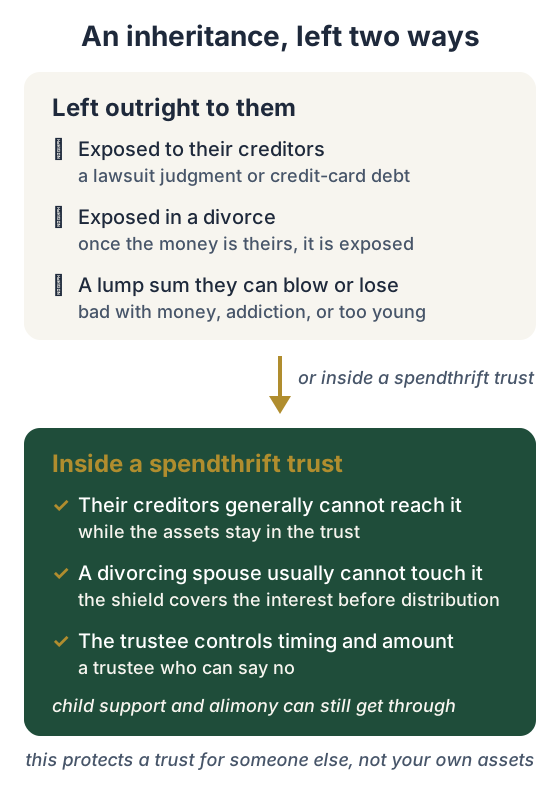
The same comparison in words.
| An inheritance left outright | Inside a spendthrift trust |
|---|---|
| Their creditors and a lawsuit judgment can reach it | Creditors generally cannot reach it until money is actually distributed |
| Exposed in a divorce, because the money is theirs | A divorcing spouse usually cannot touch the trust principal, though a support or alimony order is the recognized exception |
| A lump sum they can blow or lose | The trustee controls the timing and amount |
Worried about how an heir will handle it?
A free 30-minute consult builds the protection into your plan.
Book your free consultThe Limits
Two things to know. Florida lets certain claims through even a spendthrift clause, notably child support and alimony. We followed one of those cases from the divorce settlement all the way to the garnishment order, where four family trusts were paying every household bill for a man who had stopped writing his alimony check, in the trust that paid every bill. And a spendthrift trust protects a trust you create for someone else; you cannot use one to shield your own assets from your own creditors in Florida, that is the separate, limited world of asset protection. If your beneficiary receives public benefits, we use a special-needs trust instead, so the inheritance does not disqualify them. For the full picture of how families use these clauses inside an estate plan, read our guide to protecting your child’s inheritance.
What the Florida Statute Requires
Fla. Stat. §736.0502(1) sets one condition, and a clause that misses it is not a spendthrift provision at all. A spendthrift provision is valid only if the provision restrains both voluntary and involuntary transfer of a beneficiary’s interest. Both. A clause that stops the beneficiary assigning their interest but says nothing about creditors reaching it does not qualify.
Subsection (2) then makes the drafting easy. A term providing that the interest of a beneficiary is held subject to a spendthrift trust, or words of similar import, is sufficient to restrain both. You do not need elaborate language, you need the right language.
Subsection (3) is the operative shield. A beneficiary may not transfer an interest in violation of a valid spendthrift provision, and a creditor or assignee may not reach the interest or a distribution by the trustee before receipt by the beneficiary. Read that last phrase closely, because it is where the protection ends. Money in the beneficiary’s hands is money a creditor can take.
Subsection (4) carries a limit people are surprised by. A valid spendthrift provision does not prevent the appointment of interests through the exercise of a power of appointment.
Practice pointer. I check the two-restraint requirement first on any trust somebody else drafted, because a clause that reads protectively and only restrains voluntary transfer gives a family false comfort for years.
Can a Spendthrift Trust Be Broken?
Not broken so much as bypassed, and Florida names exactly who can do it. Fla. Stat. §736.0503(2) makes a spendthrift provision unenforceable against three classes.
- A beneficiary’s child, spouse or former spouse holding a judgment or court order for support or maintenance. The statute defines "child" to include any person for whom a child support order has been entered in this or any other state.
- A judgment creditor who provided services for the protection of the beneficiary’s interest in the trust.
- A claim of the state or the United States, to the extent a state or federal law so provides.
Those claimants can obtain a court order attaching present or future distributions. But subsection (3) attaches a condition that most summaries omit, and it matters enormously. For a child, spouse, former spouse or a services creditor, that remedy applies only as a last resort upon an initial showing that traditional methods of enforcing the claim are insufficient. They have to try the ordinary routes and fail first.
Then comes the provision that decides most of these fights. Fla. Stat. §736.0504(2) provides that whether or not a trust contains a spendthrift provision, if a trustee may make discretionary distributions, a creditor of the beneficiary, including a creditor described in §736.0503(2), may not compel a distribution subject to the trustee’s discretion, nor attach or otherwise reach the interest the beneficiary might have as a result of that discretion.
Read the cross-reference. The discretionary-trust protection reaches even the exception creditors. That is why a discretionary spendthrift trust is materially stronger than one with mandatory distributions, and it is the single most useful drafting point on this page.
Avoid mandatory distribution language in a trust for a beneficiary with support obligations or creditor exposure. A clause directing the trustee to pay income quarterly converts the strongest structure Florida offers into one of the weakest.
If the Trust Was Signed Before July 2007
The Trust Code’s validity rule does not reach it. Fla. Stat. §736.0502(1) closes by saying the subsection does not apply to any trust the terms of which are included in an instrument executed before the effective date of this code, which was July 1, 2007.
A federal bankruptcy court sitting in Florida applied that carve-out directly. In In re Ciano, 433 B.R. 431 (Bankr. N.D. Fla. 2010), the trust had been executed in 2000, and the court said that because the Trust Code’s spendthrift provisions explicitly do not apply to an instrument executed before the effective date, it had to look to pre-Trust-Code law to determine the validity of the spendthrift provision. On that older Florida common law the provision satisfied both prongs anyway, so the outcome held, but the route was entirely different.
That decision is a federal bankruptcy court reading Florida law, which makes it persuasive rather than binding on a Florida court.
Practice pointer. The date on the signature page is the first thing I look at. A trust from the 1990s or early 2000s is not governed by the statute everybody quotes, and I would rather know that before advising on it than after.
How to Set Up a Spendthrift Trust in Florida
Four decisions, and only the first is about the clause itself.
- Where it lives. Usually a subtrust inside the revocable living trust you already have, holding one beneficiary’s share rather than paying it out. Sometimes a standalone irrevocable trust.
- Whether distributions are discretionary. The §736.0504 point above. This decides how strong the structure actually is.
- Who the trustee is. A beneficiary who can write themselves cheques is not being protected from much. An independent trustee holding real discretion is what makes the discretionary protection mean something.
- What happens when the beneficiary dies. The clause protects an interest while it exists. Where that interest goes afterward is a separate drafting decision and it is easy to leave unanswered.
It is part of the Complete Trust Plan at $3,200 when built into a new plan, rather than a separate product with its own fee.
Can I Set One Up for Myself?
Clients are often confused about who a spendthrift clause protects, and ask me, "Can I put my own money in one so my creditors cannot get at it?" In Florida, no. The clause protects a beneficiary’s interest in a trust somebody else created for them. A trust you create for your own benefit is a self-settled trust, and Florida does not give it that shield. I have had this conversation with people who were told otherwise by a promoter, and the correction is better heard in my office than in a deposition.
What Florida Courts Have Held
Everything above is the plain-English version. If you want the law itself, we annotate the governing sections of the Florida Trust Code one at a time, with the statute quoted in full and the courts’ own words alongside it.
- Fla. Stat. 736.0504, discretionary trusts. The protection side. In 2010 a Florida appellate court refused to let a creditor holding a judgment of more than one million dollars reach a discretionary trust, even after the trial judge found the beneficiary controlled the trust completely and the trustee rubber-stamped him. The reason is a single sentence about where a court has to look, and it is the sentence that decides most of these fights.
- Fla. Stat. 736.0503, the exceptions. The other side. A child, spouse, or former spouse holding a support order can garnish the distributions a trustee actually makes, including payments sent to third parties on the beneficiary’s behalf. In 2019 a Florida appellate court applied that to a special needs trust and a child support arrearage. There is a last resort condition attached, and it is the part most people skip.
- Fla. Stat. 736.0505, your own trust and your creditors. The one that catches people out. A spendthrift clause does nothing against the creditors of the person who created the trust, and in a revocable trust the property answers to them exactly as if it had never been transferred. No Florida appellate court has construed it.
- The Florida Trust Code, chapter 736. How the whole chapter is organized, and which sections Florida’s appellate courts have never construed at all.
Frequently Asked Questions
How Do You Set Up a Spendthrift Trust in Florida?
Most often as a subtrust inside the revocable living trust you already have, holding one beneficiary’s share instead of paying it out at your death. It can also be a standalone irrevocable trust. The clause itself is short, because Fla. Stat. §736.0502(2) says a term providing that the interest is held subject to a spendthrift trust, or words of similar import, is enough. The decisions that take real thought are whether distributions are discretionary, who serves as trustee, and where the interest goes when the beneficiary dies.
Can a Spendthrift Trust Be Broken?
Not broken, but three classes of claimant can reach distributions anyway under Fla. Stat. §736.0503(2), being a child, spouse or former spouse with a support or maintenance order, a judgment creditor who provided services protecting the beneficiary’s interest in the trust, and the state or the United States where a law so provides. Even then, subsection (3) allows that remedy for the first two categories only as a last resort, on an initial showing that traditional methods of enforcing the claim are insufficient.
Who Is the Spendthrift Clause Intended to Protect?
The beneficiary, from their own creditors and from their own decisions, not the person who created the trust. That distinction is the one people get wrong. A spendthrift clause in a trust you set up for your child shields your child’s interest. It does nothing for you against your own creditors, because Florida does not recognise a self-settled spendthrift trust for that purpose. The clause is a protection you give, not one you keep.
What Is an Irrevocable Spendthrift Trust?
It is an irrevocable trust that contains a spendthrift clause, rather than a separate kind of instrument. The two features do different jobs. Irrevocability means the settlor cannot take the assets back, which matters for the settlor’s own creditors and for tax treatment. The spendthrift clause protects the beneficiary’s interest from the beneficiary’s creditors. A trust can be irrevocable without a spendthrift clause, and a revocable trust can contain one that takes effect for the beneficiaries after the settlor dies.
What Happens to a Spendthrift Trust When the Beneficiary Dies?
That depends entirely on what the trust says, and it is a drafting decision rather than a rule of law. The interest the clause was protecting ends with the beneficiary, and whatever remains passes to whoever the trust names next, whether that is the beneficiary’s own children, the other beneficiaries, or a remainder taker. Where a trust is silent, the outcome can surprise a family. It is worth deciding deliberately when the trust is drafted rather than leaving it for a court to work out.
Does the Spendthrift Clause Stop a Power of Appointment?
No, and Fla. Stat. §736.0502(4) says so directly. A valid spendthrift provision does not prevent the appointment of interests through the exercise of a power of appointment. So where a trust gives someone the power to direct where an interest goes, the spendthrift clause does not override that power. It restrains the beneficiary from transferring their own interest and it restrains creditors, and those are different things from a power the trust itself grants.
What Is a Spendthrift Trust?
It is a trust with a spendthrift clause, a provision that stops the beneficiary from selling, pledging, or giving away their interest, and shields that interest from the beneficiary’s creditors until money is actually distributed. The trustee controls when and how much the beneficiary receives. It is how you leave money to someone who is bad with money, has creditors or a lawsuit risk, struggles with addiction or gambling, or is simply too young or vulnerable to manage a lump sum, without leaving it exposed.
What Does It Protect Against?
While assets stay in the trust, a beneficiary’s creditors generally cannot reach them, a lawsuit judgment, credit-card debt, or a divorcing spouse usually cannot touch the trust principal. The protection applies to the beneficiary’s interest before distribution. Once the trustee hands money to the beneficiary, that money is theirs and is exposed, which is why a good spendthrift trust uses discretionary distributions and a thoughtful trustee.
What Can’t a Spendthrift Trust Do?
Two limits matter. First, Florida law lets certain claims through even a spendthrift clause, notably child support and alimony, and some governmental claims. Florida appellate courts have enforced that exception against ordinary family trusts and against a special needs trust, and it reaches payments a trustee makes to third parties on the beneficiary’s behalf as well as payments made to the beneficiary directly. Second, and this is the big one, a spendthrift trust protects a trust you set up for someone else; you cannot set up a spendthrift trust for your own benefit and shield your own assets from your own creditors in Florida. That is a different (and limited) area, asset protection, with its own rules.
Is It a Separate Trust or Part of My Plan?
Usually it is built into your existing plan. Your revocable living trust can direct that a child’s or grandchild’s share stays in a protected, spendthrift subtrust rather than being paid out at once. It can also be a standalone irrevocable trust. We design it around the specific beneficiary you are worried about, and pair it with a special-needs trust if a beneficiary receives benefits.
Can the Beneficiary Be the Trustee of a Spendthrift Trust?
It weakens the design. The shield works because someone other than the beneficiary controls the timing and amount of distributions; a beneficiary who can write themselves checks is not being protected from much. Sound Florida planning pairs the spendthrift clause with an independent trustee who holds real discretion and can say no, even to a persistent heir. Most families name a trusted independent person, a professional, or a trust company, and we help you weigh those choices at the consult.
What I See in These Files
In 14 years of law practice the spendthrift clause is the provision clients most often believe they have and most often do not. I read trusts drafted elsewhere where the protective language restrains the beneficiary from assigning an interest and says nothing at all about creditors reaching it, which under Fla. Stat. §736.0502(1) means there is no valid spendthrift provision, only the appearance of one.
I also litigate trust matters after they fail, which enhances the practice of drafting them, and the pattern I meet is a trust that was strong on paper and mandatory in its distributions. A clause directing the trustee to pay income quarterly hands a creditor a schedule. The discretionary version hands them nothing to attach, and under §736.0504(2) that holds even against the exception creditors. Avoid accepting a spendthrift clause as protection without reading whether the distributions behind it are discretionary, and avoid assuming a trust signed before July 2007 is governed by the statute everyone quotes, because it is not.
Sources of Law
- Fla. Stat. §736.0502 (annotated)(1) (valid only if it restrains both voluntary and involuntary transfer, and the carve-out for instruments executed before the effective date of the code); (2) (“held subject to a spendthrift trust, or words of similar import” is sufficient); (3) (no transfer by the beneficiary, and no creditor reach of the interest or a distribution before receipt by the beneficiary); (4) (does not prevent appointment through the exercise of a power of appointment). History, s. 5, ch. 2006-217; s. 12, ch. 2007-153. Retrieved 2026-09-14.
- Fla. Stat. §736.0503(1) (definition of “child”); (2)(a) to (c) (the three classes against which a spendthrift provision is unenforceable); (3) (attachment of present or future distributions, and the last-resort condition requiring an initial showing that traditional methods of enforcing the claim are insufficient). History, s. 5, ch. 2006-217; s. 13, ch. 2007-153.
- Fla. Stat. §736.0504(2) (whether or not the trust contains a spendthrift provision, a creditor, including one described in §736.0503(2), may not compel a discretionary distribution or attach the interest); (3) (ascertainable standard where the beneficiary serves as trustee); (4) (a beneficiary may still sue the trustee for abuse of discretion). History, s. 5, ch. 2006-217; s. 14, ch. 2007-153.
- Fla. Stat. §736.0505 (creditors’ claims against the settlor; a spendthrift clause does not shield a self-settled trust).
- In re Ciano, 433 B.R. 431 (Bankr. N.D. Fla. 2010) (Pensacola Division, decided August 6, 2010), read in full from the opinion text (⚠ a federal bankruptcy court construing Florida law, so persuasive and not binding on a Florida court): the Trust Code’s spendthrift provisions do not apply to an instrument executed before the code’s effective date, so for a trust executed in 2000 the court applied pre-Trust-Code Florida law to determine validity.
- Also construing §736.0502: Zlatkiss v. All America Team Concepts, LLC, 125 So. 3d 953 (Fla. 5th DCA 2013) and Miller v. Kresser, 34 So. 3d 172 (Fla. 4th DCA 2010), both on subsection (3); In re Rogove, 443 B.R. 182 (Bankr. S.D. Fla. 2010), subsection (3) in a footnote.
- ⚠ Stated as the limit of our own review. A section-number search of the case corpus run 2026-08-13 returned four Florida decisions touching §736.0502. We located no decision, state or federal, deciding whether particular trust language satisfies the two-restraint requirement for an instrument executed after July 1, 2007. That narrower question appears to be open, and the search was a section-number search rather than an exhaustive one.
Updated on September 14, 2026. Reviewed by Kevin D. Klagge, Esq., Fla. Bar No. 99502. Attorney Kevin Klagge represents families, businesses, and international clients in estate and tax planning, business structuring, and international law, with a focus on Florida legal tools. He litigates estate and business issues in court. General information about Florida law, not legal advice. Do not send confidential information until we have agreed to represent you.
More Guides on Florida Irrevocable Trusts
This guide is part of Florida Irrevocable Trusts.
- Florida Irrevocable Life Insurance Trust (ILIT)
- Florida QTIP Trust
- Florida QPRT (Qualified Personal Residence Trust)
- Florida Charitable Remainder Trust
- Florida Trust Decanting
- Florida Dynasty Trust
- Florida Directed Trust
Try the Florida Gift Tax Calculator.