Can You Leave Your Florida Home to Anyone You Want?
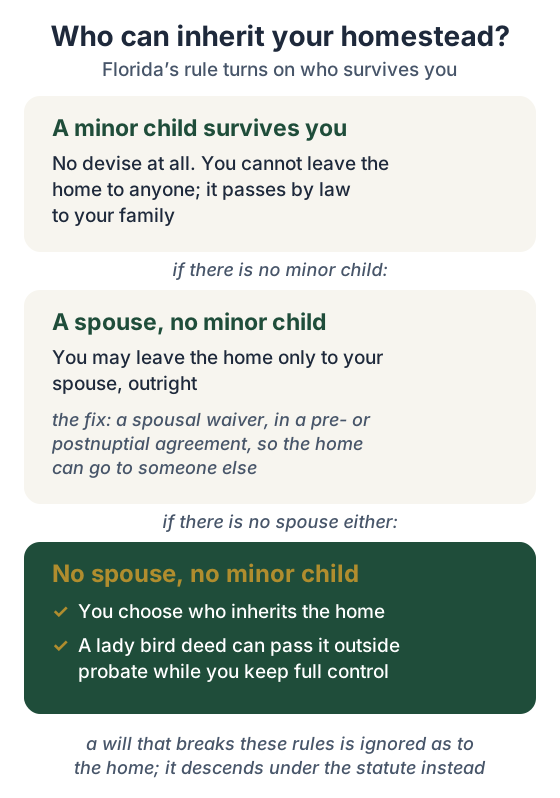
The Florida Constitution says the homestead shall not be subject to devise (a transfer at death by will or trust) if the owner is survived by a spouse or minor child. An owner survived by a spouse and no minor child may devise the homestead to that spouse. An owner survived by neither a spouse nor a minor child may leave the home to anyone.
Florida law extends this rule to a revocable trust. The grantor of a trust counts as the owner of homestead held in trust, and a disposition by trust is a devise. A will or trust that names anyone other than the surviving spouse fails when that spouse survives and there is no minor child. A will or trust that names anyone at all, including the spouse, fails when a minor child survives.
The rule applies only to a homestead. A second home or rental property that is not the owner's homestead is outside the rule.
An owner who wants the home to go to children from a first marriage faces this restriction directly. A spouse can waive the protection in a written agreement signed before two subscribing witnesses, or by joining a deed with the statutory waiver language. A lady bird deed that names the children as remaindermen (the future owners who take title at the owner's death) fails if a minor child survives, regardless of what the spouse signs.
The restriction protects the surviving spouse and any minor children. The question is whether the spouse has released that right. A minor child cannot release the protection.
What Happens If Your Will or Trust Breaks the Homestead Rule?
Title passes at the moment of death under the default rules. Florida law is specific about what happens next.
When the decedent is survived by a spouse and one or more descendants (children, grandchildren), the surviving spouse takes a life estate in the homestead. A life estate means the spouse may live in the home for life. The descendants receive a vested remainder (the part that passes at the spouse's death) per stirpes, by family line.
The surviving spouse may choose a different arrangement. In lieu of the life estate, the spouse may elect to take an undivided one-half interest in the homestead as a tenant in common (a form of shared ownership). The remaining one-half interest vests in the descendants per stirpes. The election must be made within 6 months after the decedent's death and during the spouse's lifetime.
The spouse's choice matters to the children. A life estate could last decades if the spouse is young or in good health. An undivided one-half interest gives the children ownership now.
When the decedent is survived by descendants and no spouse, the home descends to the descendants per stirpes. Each line of the family takes a share outright, with no life estate to anyone.
A trust that violates the homestead restriction fails in the same way. Florida law says that if a devise of homestead under a trust violates the constitutional limitation, title shall pass under the default rules at the moment of death. The rule applies to revocable trusts and to testamentary trusts.
Want your home to go to the right people?
Book a free consultation with Attorney Kevin D. Klagge, Esq. We will make sure your plan for the home actually works under Florida’s rules.
Book a free consultationDoes the Rule Apply to a Revocable Trust?
The homestead restriction applies to a revocable trust. The Florida statute defines "owner" to include the grantor of a trust that is evidenced by a written instrument in existence at the time of the grantor's death. The grantor is treated as if the interest held in trust was owned by the grantor directly.
The statute also defines "devise" to include a disposition by trust. The portion of the trust estate that would be the grantor's homestead, if titled in the grantor's name, falls under the constitutional rule. A trust provision directing the homestead to anyone other than the surviving spouse fails when a spouse survives and there is no minor child. A trust provision directing the homestead to anyone, including the spouse, fails when a minor child survives.
Funding a home into a revocable trust does not avoid the restriction. A deed moving the home into a trust during the owner's lifetime transfers title to the trustee, but the homestead character follows. The grantor remains the owner for purposes of the devise rule. The trust's terms at death control whether the disposition is valid.
A trust that breaks the rule does not void the entire trust. Only the homestead provision fails. Title to the home passes at the moment of death under the default rules, which means a life estate to the spouse with a remainder to the descendants, or the spouse's election of a one-half interest within 6 months.
A spouse can waive the homestead right in a written agreement signed before two subscribing witnesses, or by joining any deed that carries the statutory waiver statement. A minor child's protection cannot be waived.
Can Your Spouse Waive the Homestead Rule?
A spouse can waive the homestead right. Florida law allows a written contract, agreement, or waiver signed by the waiving party in the presence of two subscribing witnesses. The waiver may be signed before or after marriage.
A waiver signed after marriage requires fair disclosure. Each spouse must make a fair disclosure to the other of that spouse's estate. No disclosure is required for an agreement signed before marriage. A prenuptial agreement covering the homestead needs no disclosure. A postnuptial agreement does.
A deed can also carry a waiver. Florida law provides specific language that works. The statute says a spouse waives homestead rights regarding the devise restriction if the deed includes words to this effect. "By executing or joining this deed, I intend to waive homestead rights that would otherwise prevent my spouse from devising the homestead property described in this deed to someone other than me."
The deed waiver is narrow. The statutory language waives only the restriction against devising the homestead to someone other than the spouse. The waiver does not release the spouse's elective share (the 30 percent of the estate a surviving spouse can claim) in the estate generally. The waiver does not release the homestead's protection from the owner's creditors during life and after death. The waiver does not release the requirement that the spouse join any sale, mortgage, or gift of the homestead during the owner's lifetime.
A postnuptial agreement can be broader. The spouse may waive the elective share, the intestate share, the homestead right, and the preference in appointment as personal representative. The agreement must be signed before two subscribing witnesses and must include fair disclosure of each spouse's estate.
The difference matters at death. A deed waiver lets the owner devise the home to someone else, but the spouse keeps the elective share and other rights. A full postnuptial waiver releases all spousal rights, including the elective share. A prenuptial agreement signed before the marriage requires no disclosure and may cover all the same rights.
Does a Lady Bird Deed Get Around the Restriction?
A lady bird deed (an enhanced life estate deed) passes the home at the owner's death without probate. The remainder, the part that passes at death, is a disposition of homestead. The same constitutional rule applies. A lady bird deed that names anyone other than the spouse fails if the owner is survived by a spouse, unless the spouse waives the restriction. A lady bird deed that names anyone, including the spouse, fails if a minor child survives. No waiver can protect you then.
A spouse can waive the restriction by signing the deed itself. The deed carries a statement in substantially the words provided by Florida law. The spouse signs the same deed the owner signs. Both signatures are notarized.
The waiver in the deed is narrow. The deed statement waives only the devise restriction. The statement does not waive the elective share, protection from creditors during life and after death, or the requirement that a spouse join a sale, mortgage or gift of the homestead while both are alive.
A minor child's protection cannot be waived. If a minor child survives the owner, a lady bird deed naming anyone else fails, even if the deed names the spouse. The home passes under the default rules. The arrangements that do work while a child is under 18 are set out in the guide to a lady bird deed with a minor child.
A lady bird deed for one owner is a $399 flat fee, or $449 for a couple, plus recording. The Secure Will Estate Plan, from $1,200 for one person or $1,950 for a couple, includes a lady bird deed on the home. Recording is additional.
Can You Give the Home Away While You Are Alive?
Florida law treats a gift, sale or mortgage during the owner's lifetime differently from a transfer at death. The Florida Constitution says the owner of homestead, joined by the spouse if married, may alienate the homestead by mortgage, sale or gift and may by deed transfer the title to an estate by the entirety with the spouse. Alienate means transfer to someone else.
The rule applies to married owners. Both spouses must sign. A deed of the homestead that the spouse did not join is void, meaning it has no legal effect at all. One Florida appeals court, quoting an earlier Florida decision, put it this way. "A purported transfer of the homestead, not in compliance with constitutional requirements, is void."
The minor-child restriction works differently during life. The constitution limits what the owner can do at death when a minor child survives. A married couple with minor children can sell their home or give it away, so long as both spouses sign the deed.
When both spouses sign, the home can go to anyone the couple chooses. An adult child, a sibling, a trust, a buyer, or any other person can receive title. The spouses give up the homestead together. A lifetime transfer to an irrevocable homestead trust is the planned version of that gift.
What Florida Courts Have Said
The Mendia case, decided in 2025 by the Third District Court of Appeal, shows how the rule works in practice. A husband and wife married in 1961. In 1998, because of the husband's gambling, they signed a postnuptial agreement and the husband quitclaimed the home to his wife. Neither the agreement nor the deed addressed homestead rights or what would happen at death.
In 2021, the wife signed a quitclaim deed transferring the home to her second cousin. A nonlawyer prepared the deed and served as the notary. The husband did not sign the deed and apparently did not know about it. She died two months later at 85, still married after more than 59 years. Both spouses had lived in the home until her death.
The trial court held the 2021 deed void because the husband did not join it. The court found that the husband had not explicitly waived his homestead rights in the 1998 papers. The appeals court affirmed. Quoting an earlier Florida decision, the court wrote that "[i]n order to find that a survivor spouse has waived/relinquished homestead protection, evidence must demonstrate the survivor’s intent to waive the constitutional and statutory claim to homestead property."
The Rogers case, also from the Third District in 2025, involved a husband who used a power of attorney to sign a deed on his wife's behalf. The deed moved the couple's home to the husband for life with the remainder to another man. The deed did not contain the statutory waiver statement. The husband died in January 2022. The man who received the remainder claimed he had paid $100,000 plus a $50,000 note for it.
The trial court held the deed failed to transfer title. The home passed to the wife as the surviving spouse. The appeals court affirmed, finding the quitclaim deed void because it failed to contain sufficient language waiving homestead rights.
The pattern across both cases is that a deed without the spousal joinder or the waiver statement does not transfer title. The Mendia deed was void because the spouse never signed at all. The Rogers deed was void because it did not include the statutory waiver language. When the owner wants the remainder of a lady bird deed to pass to someone other than the spouse, the firm drafts the deed with the exact statutory language and the spouse's signature.
How Do You Leave Your Home to Your Children, Step by Step?
The first step is to confirm who would survive you. The answer determines what is possible. With a minor child surviving, the home cannot go to anyone by will or by the remainder in a lady bird deed. A lifetime transfer with both spouses signing can pass the home, but the devise restriction at death cannot be waived. With a spouse and no minor child, the spouse can waive the restriction.
The second step is the waiver, if one is needed. A spouse can sign a prenuptial or postnuptial agreement waiving homestead rights. A prenuptial or postnuptial agreement is a flat fee quoted at the consultation. The agreement must be signed before two subscribing witnesses. An agreement signed after marriage requires fair disclosure of each spouse's estate. The spouse can also sign a deed that carries the statutory waiver statement.
The third step is to choose the right document. A revocable trust can hold the home and pass it outside probate, though the trust's grantor is treated as the owner for the homestead rule. A lady bird deed passes the home at death without probate and lets the owner keep full control during life. A lady bird deed for one owner is $399 flat fee, or $449 for a couple, plus recording.
The fourth step is signing. A deed requires two subscribing witnesses and a notary. Florida law allows both witnesses to be present through audio-video communication technology, so you can sign from home. Each remote witness must verbally confirm that he or she is a resident of and physically located within the United States or a territory of the United States at the time of witnessing. A spousal waiver in a prenuptial or postnuptial agreement is on the list that carries extra screening questions when signed remotely with fewer than two witnesses in the physical presence of the person signing.
The free consultation covers your facts and confirms which documents fit.
Frequently Asked Questions
Can I Leave My Florida Home to Whoever I Want?
Florida's Constitution says the homestead may not be devised if a spouse or minor child survives. If you leave a spouse and no minor child, your will may leave the home only to your spouse, unless your spouse waives the restriction. If a minor child survives, the home may not be devised at all. With neither a spouse nor a minor child, you may leave the home to anyone. The restriction applies whether the disposition is in a will or a revocable trust.
What Happens if My Will Violates the Homestead Rule?
The will's instruction fails and Florida's default rules take over at the moment of death. When a spouse and descendants survive, the spouse receives a life estate in the home and the descendants receive the remainder. The spouse may instead elect within 6 months to take an undivided one-half interest as a tenant in common, with the other half going to the descendants. With descendants and no spouse, the home descends to the descendants. A trust that violates the rule passes title the same way.
Can I Disinherit My Spouse From the Home?
A surviving spouse will receive either a life estate or a one-half interest when descendants also survive, unless the spouse has waived that right. When there are no descendants, Florida's default inheritance rules apply. A waiver may appear in a prenuptial or postnuptial agreement signed before two subscribing witnesses. An agreement signed after marriage must include fair disclosure of each spouse's estate. A spouse may also waive the devise restriction by signing a deed that carries Florida's statutory waiver statement. Absent a proper waiver, your spouse cannot be cut out of the homestead.
How Can I Leave My Home to My Children Then?
Your spouse must waive the homestead devise restriction, and the waiver works only if no child is a minor at your death. The waiver can be part of a prenuptial or postnuptial agreement, or your spouse can sign a deed (including a lady bird deed) that includes the statutory language waiving the restriction. Once the spouse has waived and no minor child survives, your will or trust may leave the home to your children. If you are not married and have no minor children, you may leave the home to anyone without a waiver.
Does a Lady Bird Deed Get Around the Restriction?
A lady bird deed's remainder is a disposition of homestead. The same constitutional rule applies. If a minor child survives, the deed fails and title passes under the default rules. If a spouse survives with no minor child, the spouse may sign the deed with Florida's statutory waiver statement, or the spouse may waive in a witnessed agreement signed before or after marriage. A lady bird deed prepared without the waiver will not override the spouse's right to the home.
What Is a Homestead Waiver?
A homestead waiver is a written agreement (a prenuptial or postnuptial agreement) or a deed that gives up the surviving spouse's right to the homestead. A waiver agreement must be signed before two subscribing witnesses. A deed must include language stating the signing spouse intends to waive the homestead devise restrictions. The deed statement waives only the devise restriction. It does not waive the elective share, creditor protection or the requirement that a spouse join a sale or mortgage during the owner's life.
Can I Leave My Home to My Spouse if I Have a Minor Child?
A homestead cannot be devised at all when the owner is survived by a minor child. The Florida Constitution provides that the homestead shall not be subject to devise if the owner is survived by a minor child. A will leaving the home to the spouse fails if a minor child also survives. The home passes under the default rules, giving the spouse a life estate with the remainder to the descendants, or the spouse may elect within 6 months to take a one-half interest as a tenant in common.
Does the Homestead Rule Apply to a Second Home or Rental Property?
The homestead devise restriction applies only to property that is the owner's homestead. A second home or rental property that is not the owner's homestead is outside the rule. You may leave it to anyone by will or trust. The restriction exists because the Florida Constitution protects the family residence. The free consultation covers how other spousal rights may apply and what the facts of your situation require.
Does the Rule Apply if My Spouse and I Own the Home Together?
The rule applies to any homestead the owner tries to devise away from a surviving spouse or minor child. If a married couple owns the home as tenants by the entirety, the surviving spouse takes the whole property by operation of law at the first death, and the devise restriction does not come into play. How other forms of ownership interact with the restriction depends on the facts. The free consultation covers how your ownership affects the options.
What if I Remarry After Signing a Will or Lady Bird Deed?
A spouse who is married to the owner at death is protected under the homestead rule, even if the will was signed before the marriage. The question that Florida courts have not settled is whether a lady bird deed signed before the marriage overrides a later spouse's protection. The free consultation covers what the current law says about your situation and whether any planning steps can help.
Can My Spouse Sign the Waiver After I Sign the Deed?
A spouse may sign a separate written waiver after the owner has already signed a deed. Florida law allows the homestead rights to be waived by a written contract, agreement or waiver signed by the waiving party in the presence of two subscribing witnesses. If signed after marriage, the law requires each spouse to make a fair disclosure to the other of that spouse's estate. A prenuptial or postnuptial agreement is a flat fee quoted at the consultation.
What Happens to the Home if My Children Are Grown and I Am Not Married?
An unmarried owner with no minor children may leave the Florida homestead to anyone. The constitutional restriction protects only a surviving spouse and minor children. With neither, the owner chooses freely by will, trust or lady bird deed. A lady bird deed to adult children, flat fee from $399 plus recording, passes the home outside probate and keeps the owner's full control during life. If the owner does nothing, the home passes under intestate succession to the descendants. The free consultation confirms whether any protected person would survive.
Common Situations
A widow in her late seventies wanted to leave her home to her two adult daughters. Her husband had died years earlier, and both children were over 40. Because no spouse or minor child would survive her, she was free to choose the recipient. She signed a lady bird deed naming the daughters as remaindermen, flat fee from $399 plus recording. The deed kept her in full control of the home for the rest of her life, and at her death the property passed to the daughters without probate and without any challenge to the devise.
A single owner wanted the home to pass to adult children at his death. His spouse had signed a postnuptial agreement with fair disclosure, waiving her homestead rights before two witnesses. Because the spouse had waived and no minor child would survive, the owner signed a lady bird deed naming the children as remaindermen. At the owner's death, the deed's remainder passed the home to the children without probate.
Chapters 10, 11 and 22 of Kevin D. Klagge’s free book, Are Florida Lady Bird Deeds Just for Women?, cover this question with every statute and case cited to its source.
Sources of Law
- Fla. Const. Art. X §4(c) (homestead may not be devised if survived by spouse or minor child). Fla. Stat. §732.4015 (devise restriction); §732.401 (descent when devise is barred); §732.702 and §732.7025 (spousal waiver). Lorraine v. Grover, Ciment, 467 So. 2d 315 (Fla. 3d DCA 1985). flsenate.gov (retrieved 2026-06-08)
Updated on October 27, 2026. Reviewed by Kevin D. Klagge, Esq., Fla. Bar No. 99502. General information about Florida law, not legal advice, and no attorney-client relationship is created. Homestead outcomes depend on your family and facts. Do not send confidential information until we have agreed to represent you.
More Guides on Florida Homestead Law
- Florida Homestead Exemption for Non-US Citizens
- Florida Save Our Homes Cap, and What Resets It
- Florida Save Our Homes Savings by County (Dataset)
- What Is Homestead Property in Florida?
- How Much Does Homestead Exemption Save in Florida?
- How to File for Homestead Exemption in Florida
- Florida Homestead Exemption: How Long Must You Live Here?
- Florida Amendment 3: Will It Eliminate Property Taxes?
Try the Which Estate Plan Do I Need? (quiz).