Can a Trust Own an LLC in Florida?
A trust can own an LLC. What moves is the membership interest. The LLC keeps owning its property and its contracts. The trustee holds the interest, but the trustee is a transferee (a person who receives distributions but cannot manage the company or see its records) until admitted as a member.
Florida law allows a transfer of a transferable interest (the economic right to receive distributions). The statute says "[i]s permissible" and "[d]oes not by itself cause a member's dissociation or a dissolution and winding up of the limited liability company's activities and affairs." The company keeps running. The transfer does not force anyone out and does not wind anything up. A transfer that breaks a restriction in the operating agreement, however, is ineffective against any person who has knowledge or notice of the restriction at the time of the transfer.
After the transfer, a person becomes a member as provided in the operating agreement, or with the consent of all the members. The operating agreement controls who can hold an interest and who can actually vote and manage. If you are the sole member and you transfer your interest to your revocable trust, you usually keep running the company as trustee once you are admitted as a member. The trust document names who takes over after you.
The LLC interest moves by a written assignment to the trustee, together with whatever the operating agreement requires. If the agreement requires the consent of other members or an amendment to the member list, those steps happen at the same time.
What Happens to Your LLC If You Die Without a Plan?
Death dissociates (ends the membership of) a member from the company. Florida law says a person is dissociated as a member if "[t]he individual dies." The membership ends at that moment. What happens next depends on what the operating agreement says and how many members the company has.
The personal representative (the person a probate court appoints to settle your estate) may exercise your rights "for the purpose of settling the member's estate." The personal representative steps in to collect the interest and distribute it to whoever inherits. If there is a dispute about who inherits or what the interest is worth, the probate court decides.
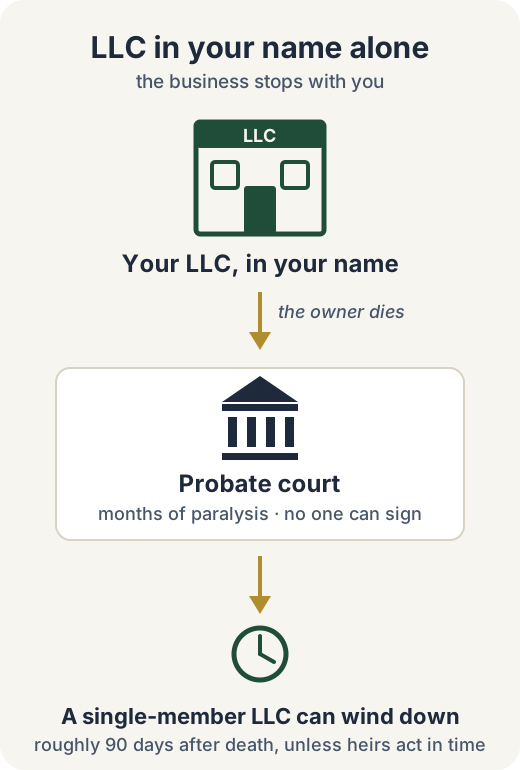
A single-member company has a harder problem. Florida law says a limited liability company is dissolved and must be wound up upon "[t]he passage of 90 consecutive days during which the company has no members." The statute allows an exception if transferees holding a majority of distributions consent to admit a person, and that person becomes a member. If no one acts, the company dissolves by operation of law.
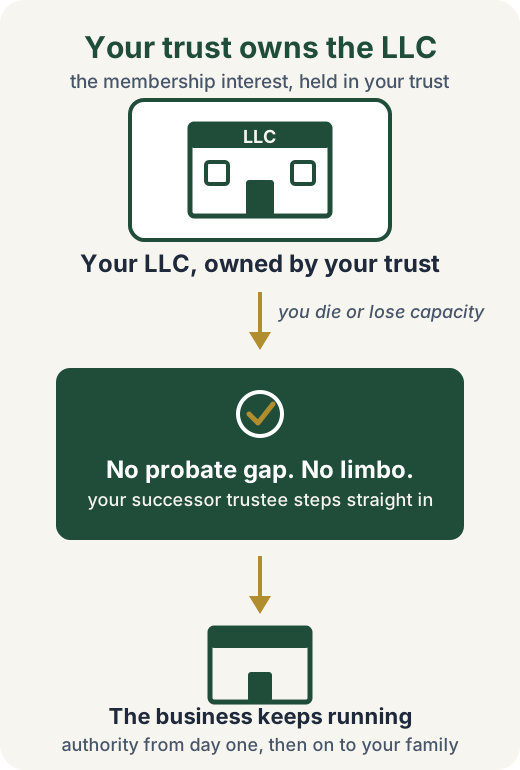
A trust changes the sequence. When the trust owns the interest, the trust does not die. The successor trustee steps in under the trust document. The operating agreement should say what happens when a member that is a trust continues after the death of the person who made it. If the agreement is drafted for that transition, the successor trustee takes over without probate and without the 90-day clock starting. Keep in mind that when the trust later distributes its entire interest to a beneficiary, the trustee-member is dissociated, and a single-member company faces the 90-day rule again at that point.
Trust or LLC: What Does Each One Do?
An LLC limits business liabilities. A trust decides who inherits and who takes control at death or incapacity. The two solve different problems and work together.
The LLC is a legal entity that owns property, enters contracts, and carries the liabilities of the business. Florida law makes a charging order (a lien that directs the company to pay distributions to a creditor) "the sole and exclusive remedy" by which a judgment creditor of a member may satisfy a judgment from the member's interest in a company with more than one member. The charging order limits a member's personal creditor's remedy against the member's interest. In a multi-member company, the creditor gets a lien on distributions but cannot force a foreclosure sale. In a single-member company, a court may order a foreclosure sale on the creditor's showing.
A revocable trust is different. Florida law says "[t]he property of a revocable trust is subject to the claims of the settlor's creditors during the settlor's lifetime to the extent the property would not otherwise be exempt by law if owned directly by the settlor." The trust adds no protection while you are alive. What the trust does is control the succession. The trust document names who takes over as trustee if you become incapacitated and who inherits the interest when you die. The transfer happens under the trust terms, outside probate.
| Question | LLC | Revocable Trust |
|---|---|---|
| What it is | A legal entity that holds business property | An arrangement that holds assets for your benefit and then for your successors |
| What it protects against | Claims against the business reaching your personal assets | Probate delay and court involvement at death or incapacity |
| What happens at death | The membership interest passes through probate unless it is held in a trust | The successor trustee takes over under the trust document |
| Probate required | Yes, for the interest, unless planned otherwise | No, for assets actually funded into the trust |
| Who runs it | The members or managers under the operating agreement | The trustee, following the trust document |
The combination puts the LLC inside the trust. The LLC keeps limiting liabilities. The trust keeps the interest out of probate and names who steps in.
How Do You Put an LLC Into a Trust?
The LLC itself stays where it is. Your membership interest moves to the trustee by a written assignment. After the assignment, the trustee holds the interest. You, as trustee of a revocable trust, usually keep running the company the same way you always have once you are admitted as a member.
The operating agreement controls what the assignment requires. The agreement may call for the written consent of the other members, an amendment, or an updated member schedule. Florida law gives you the right to transfer "in whole or in part" your transferable interest, but a transfer that breaks a restriction in the operating agreement is ineffective against anyone who has knowledge or notice of the restriction at the time of transfer. If you ignore the agreement, the other members can treat the assignment as though it never happened.
A transfer of your interest does not by itself make the trustee a member. Under Florida law, a transferee receives distributions that would otherwise go to the transferor, but the transferee cannot participate in management or access the company's records unless the transferee becomes a member. Becoming a member after formation happens as provided in the operating agreement, or with the consent of all the members. Without that step, the trustee holds a bare economic interest with no voting rights.
The mechanics of the assignment and the operating agreement requirements are covered at the free consultation.
What Should You Check in the Operating Agreement First?
The operating agreement is the starting point. Look for any provision that restricts who may hold an interest, whether the other members must consent to a transfer, and whether the company must amend its records when a transfer occurs. Florida law says "[a] transfer of a transferable interest in violation of a restriction on transfer contained in the operating agreement is ineffective as to a person who has knowledge or notice of the restriction at the time of transfer."
Check whether a transferee becomes a member or remains only a transferee. Under Florida law, a transferee "has the right to receive, in accordance with the transfer, distributions to which the transferor would otherwise be entitled." A bare transferee, however, cannot participate in management or see the company's records. If the agreement does not admit the trustee as a member, the interest receives money but has no vote and no control. A person becomes a member as provided in the operating agreement, or with the consent of all the members.
Look at what the agreement says happens when a member dies. Florida law provides that death dissociates a member and that a legal representative may exercise all of the member's rights for settling the estate, "including any power the member had to give a transferee the right to become a member."
Write down these provisions before you draft the assignment. If the agreement needs changes to let the trustee hold the interest the way you want, amend it first. The assignment follows.
Revocable or Irrevocable: Which Trust Should Own the LLC?
A revocable trust is one you can change or cancel while you are alive. You are taxed on its income as though you still owned the property yourself. Under federal tax law, "[t]he grantor shall be treated as the owner of any portion of a trust" where the grantor can "revest" title in himself. For a business owner, the revocable trust works the same way holding the interest outright does, except that at death or incapacity the trust document already names who takes over without waiting for a court to appoint anyone.
The revocable trust does not shield your assets from creditors while you are alive. Florida law says "[t]he property of a revocable trust is subject to the claims of the settlor's creditors during the settlor's lifetime to the extent the property would not otherwise be exempt by law if owned directly by the settlor." If a judgment creditor could reach the interest you hold now, the creditor can reach the interest after you move it into a revocable trust.
An irrevocable trust is different. You give up the right to revoke it, and the property inside may or may not be reachable by your creditors, depending on how the trust is structured and whether you kept certain powers. An irrevocable trust is a flat fee quoted at the consultation after we have talked through what you are trying to accomplish.
For a person whose main concern is avoiding probate and keeping the business running at death or incapacity, the revocable trust does the job. A complete trust plan, including a revocable trust, a pour-over will, powers of attorney and funding help, is a flat fee from $3,200, or $4,500 for a couple.
Want your business to outlive you, cleanly?
Book a free consultation with Attorney Kevin D. Klagge, Esq. We will confirm your operating agreement allows it and put the business in a trust the right way.
Book a free consultationDoes a Trust Protect Your LLC From Lawsuits?
A trust and an LLC protect against different problems. The LLC stands between the business and your personal assets. The trust decides who controls and who inherits the LLC interest. Neither one is a substitute for the other.
Florida law makes a charging order the way a personal creditor reaches an LLC interest. A creditor with a judgment against you can get a court order that directs the company to pay distributions to the creditor instead of to you. The statute says "a charging order is the sole and exclusive remedy by which a judgment creditor of a member or member's transferee may satisfy a judgment from the judgment debtor's interest in a limited liability company." The charging order is a lien on distributions. In a multi-member company, the creditor gets the lien but cannot force a foreclosure sale.
A single-member company is different. The statute allows a court to order a foreclosure sale of the interest when the creditor shows "distributions under a charging order will not satisfy the judgment within a reasonable time." A court can make that finding at the same time it enters the charging order. A foreclosure sale gives the purchaser the entire interest.
A revocable trust adds nothing to this picture during your lifetime. Florida law says "[t]he property of a revocable trust is subject to the claims of the settlor's creditors during the settlor's lifetime to the extent the property would not otherwise be exempt by law if owned directly by the settlor." The LLC interest you move into your revocable trust stays just as reachable by your creditors as it was before. The trust is about succession. Whether an irrevocable trust fits your situation, and the fee for one, is covered at the consultation.
Can a Trust Own S Corporation Stock?
An S corporation can have only certain shareholders. The tax code lists the trusts that qualify. A revocable trust of an individual who is a citizen or resident of the United States qualifies while that person is alive. The statute describes "[a] trust all of which is treated (under subpart E of part I of subchapter J of this chapter) as owned by an individual who is a citizen or resident of the United States."
The same trust continues to qualify for two years after the owner's death. The code covers "[a] trust which was described in clause (i) immediately before the death of the deemed owner and which continues in existence after such death, but only for the 2-year period beginning on the day of the deemed owner's death."
After those two years, the trust must fit another category, the stock must be distributed out of the trust, or the S election is lost. Which path applies depends on how the trust is drafted and what happens with the estate.
I work through these questions at the free consultation. We look at your trust and your business, and I tell you what changes, if any, the trust needs before the company moves into it or before you die.
Should Your House Go in a Trust or an LLC?
Florida's homestead protection is written into the constitution. The protection belongs to a natural person. When you put your home in an LLC or a corporation, you lose the constitutional exemption.
A Florida appeals court said it plainly. A president and sole shareholder of a corporation lived in a house the corporation owned. A visitor was injured and won a judgment of $390,649.64 against the corporation. The trial court held that homestead attached. The appeals court reversed. The court said "the plain language of the Florida Constitution requires that the owner of the property be a natural person to claim the homestead exemption." The court added that the shareholder's status "did not give her an interest in the corporation's property."
Whether a revocable trust keeps homestead treatment depends on your facts and is covered at the consultation. The choice between a trust and a company for a residence is what we sort out there.
What Florida Courts Have Said
Florida courts have decided cases that show what goes wrong when a business or a house is held the wrong way.
In a Second District case, a corporation owned the home where its sole shareholder lived. A visitor was injured on the property in 2012 and sued the corporation. In 2014, while the lawsuit was pending, a quitclaim deed was recorded from the corporation to the president, but the deed had defects. The injured visitor won a final judgment of $390,649.64 in December 2015. The trial court held that homestead attached, but the appeals court reversed. The court explained that "the plain language of the Florida Constitution requires that the owner of the property be a natural person to claim the homestead exemption." The court also noted that the president's status as sole shareholder "did not give her an interest in the corporation's property." The $390,649.64 judgment reached the house because the corporation held title.
A different Second District case involved a trust and a house. A granddaughter alleged that in January 2018 her grandmother hired a lawyer to draft an amendment to her trust giving the granddaughter an interest in a piece of real property. The grandmother died in August 2018. The granddaughter alleged the lawyer had discussed preparing and recording deeds, but no deed had ever been prepared. She alleged the property was never transferred into the trust. The court, reciting her allegations, stated that "because no deed had ever been prepared to transfer the 17th Street Property into the trust, it was an unfunded devise and, therefore, Ellerson did not receive her undivided interest in the property." The appeals court reversed the dismissal and held that whether the lawyer undertook to fund the trust was a question of fact. The case was about a house, and the same principle applies to an LLC interest.
Common Mistakes Owners Make
The first mistake is signing a trust and never assigning the LLC interest into it. A trust controls only what is actually transferred to the trustee. An LLC interest that stays in the owner's name goes through probate like any other asset.
The second mistake is ignoring the operating agreement. Florida law says "[a] transfer of a transferable interest in violation of a restriction on transfer contained in the operating agreement is ineffective as to a person who has knowledge or notice of the restriction at the time of transfer." An assignment that breaks a restriction may not work. The agreement may require the consent of the other members, may limit who can become a member, or may say what happens at a member's death. Skipping this step can leave the surviving family with an assignment that the other members refuse to honor.
The third mistake is titling a home in an LLC or corporation for asset protection and losing the homestead exemption. Florida's constitution protects a homestead owned by a natural person. A company is not a natural person. The corporation in the Second District case lost that protection, and the $390,649.64 judgment reached the house.
The fourth mistake is assuming a revocable trust shields the business from the owner's creditors. Florida law says "[t]he property of a revocable trust is subject to the claims of the settlor's creditors during the settlor's lifetime to the extent the property would not otherwise be exempt by law if owned directly by the settlor." A revocable trust adds nothing during life.
Frequently Asked Questions
Can a Trust Own an LLC?
A trust can own an LLC in Florida. The trustee holds the membership interest, and the LLC continues to own its own property. Florida law allows a transfer of a transferable interest in an LLC, and the transfer does not by itself cause dissociation or dissolution. For a revocable trust, the person who made the trust usually keeps running the company as trustee once admitted as a member. The mechanics of the assignment and any operating agreement requirements are covered at the free consultation.
What Happens to My LLC if I Die Without a Trust?
An LLC interest that is not in a trust goes through probate when the owner dies. Florida law says that death dissociates the member, and a personal representative steps in to settle the estate. For a single-member company, Florida law also provides that if no member exists for 90 consecutive days, the company is dissolved unless transferees holding a majority of distribution rights consent to admit a new member and someone becomes a member under that consent. The three-month creditor period in probate means the administration takes at least that long.
What's the Difference Between a Trust and an LLC?
An LLC is an entity that holds property and limits the business's liabilities. A trust is an arrangement that decides who controls and who inherits an interest at death or incapacity. The LLC shields the owner from business debts. The trust passes the LLC interest without probate and names a successor trustee. The two solve different problems and work together. A revocable trust during the owner's life stays reachable by the owner's creditors, just as the assets would be if the owner held them directly.
Should I Put My LLC in a Revocable or an Irrevocable Trust?
A revocable trust is taxed to the owner while alive under federal tax law. The owner keeps control and can change or end the trust at any time. Florida law provides that a revocable trust's property is subject to the owner's creditors during life to the extent it would be if owned directly. An irrevocable trust is a different decision, with its own fee quoted at the consultation. Which one fits depends on your facts and is covered there.
What Do I Need to Check Before Transferring My LLC to a Trust?
The operating agreement should be the first document you check. Florida law provides that a transfer of an LLC interest that violates a restriction in the operating agreement is ineffective against anyone who has knowledge of the restriction at the time of transfer. Look for consent requirements, admission rules (whether the trustee becomes a member or only a transferee), and what the agreement says happens at death. A transferee who is not admitted as a member receives distributions but has no vote.
Does Putting My LLC in a Trust Cause Taxes?
A revocable trust is taxed to its maker while the maker is alive. Federal tax law treats the owner of a revocable trust as the owner of the trust's property for income tax purposes. The rest of the answer depends on how the LLC itself is taxed and is covered at the free consultation. Bring your most recent tax return for the business.
Does a Trust Protect My LLC From Lawsuits?
A revocable trust adds no creditor protection during the owner's life. Florida law says the property of a revocable trust is subject to the owner's creditors to the extent it would be if the owner held it directly. The LLC itself may offer protection. For a company with more than one member, a charging order is the sole and exclusive remedy by which a judgment creditor may reach the debtor's interest. For a single-member company, a court may order a foreclosure sale if the creditor shows that distributions will not satisfy the judgment within a reasonable time.
How Much Does It Cost to Put My Business in a Trust?
A Complete Trust Plan, which includes the revocable trust, a pour-over will, powers of attorney and funding help, is a flat fee from $3,200, or $4,500 for a couple. Assigning the LLC interest to the trust, reviewing or amending the operating agreement, and any business succession work is a flat fee quoted at the consultation. Government costs are extra and passed through at cost.
Can a Trust Own a Business?
A trust can own a business interest, including a membership interest in a limited liability company. The trustee holds the interest for the beneficiaries named in the trust. For a revocable trust, the person who made the trust usually keeps running the business as trustee during life. The operating agreement may require consent from the other owners before the trust can be admitted as a member with voting rights. A transfer of an LLC interest that violates a restriction is ineffective against someone who knows about the restriction.
Can a Trust Own an S Corp?
An S corporation may have certain trusts as shareholders. A revocable trust qualifies during the life of the person who made it, and it continues to qualify for 2 years after that person dies. After the 2 years, the trust must meet another qualifying form or distribute the stock, or the corporation loses its S election. The path that fits depends on how the trust is drafted and who inherits, and is covered at the free consultation.
Should I Put My House in a Trust or an LLC?
Florida's homestead protection belongs to a natural person. The Florida Constitution requires that the owner of the property be a natural person to claim the exemption. A corporation or LLC cannot claim homestead protection. One Florida corporation's shareholder lost homestead protection on a home titled in the corporation even though she lived there and later tried to transfer the property to herself individually. Whether a revocable trust keeps homestead treatment depends on your facts and is covered at the consultation.
Can an LLC Be Put in a Revocable Trust in Florida?
A membership interest in a Florida limited liability company can be assigned to a revocable trust. The owner signs a written assignment of the interest to the trustee, and the operating agreement's transfer rules apply. Florida law allows the transfer but does not by itself make the trustee a member with voting rights. The trustee becomes a member as provided in the operating agreement, or with the consent of all the members. The transfer does not dissolve the company or change who runs it day to day.
Who Runs My LLC After I Die if the Trust Owns It?
The successor trustee named in the trust takes over as the holder of the membership interest. The successor trustee steps in according to the trust's instructions, and if the trust directs a distribution of the interest, the beneficiary may apply to become a member under the operating agreement.
Does the LLC Need a New EIN When the Trust Becomes the Owner?
The answer depends on how the company is taxed and is covered at the free consultation. The transfer of a membership interest to a revocable trust does not change the company's legal existence or its property. What changes is who owns the interest. Bring your operating agreement and your most recent tax return to the consultation and we will sort it out.
Does Real Estate Held in an LLC Still Go Through Probate?
Real estate owned by a limited liability company stays titled in the company's name. The property itself does not go through probate because the company holds the title. What goes through probate is the membership interest if the owner held it individually and died without a trust. When the trust owns the interest, the successor trustee takes over under the trust's instructions rather than through probate. A single-member company with no member for 90 consecutive days is dissolved unless a new member is admitted, which affects the property inside.
Does Putting a Single-Member LLC in a Revocable Trust Change Its Protection?
A revocable trust does not add creditor protection during the owner's lifetime. Florida law provides that the property of a revocable trust is subject to the claims of the settlor's creditors to the same extent it would be if owned directly. For a single-member limited liability company, a judgment creditor who shows that distributions under a charging order will not satisfy the judgment within a reasonable time may ask the court to order a foreclosure sale of the interest. Moving a single-member company into a revocable trust does not change that outcome.
Common Situations
A father ran a small consulting firm through a single-member LLC. He signed a revocable trust and told his daughter it would handle everything at his death. He never assigned the membership interest to the trust. When he died, the LLC interest had to go through probate. Under Florida law, a company with no members for 90 days is dissolved unless the transferees consent to admit a new member and at least one person becomes a member. The daughter had to hire an attorney and open a formal administration, a flat fee from $3,500, to rush the paperwork and save the company before the 90 days ran.
A couple owned rental property through a multi-member LLC. Each held a 50 percent membership interest and assigned the interests to their revocable trusts. When the husband died, his successor trustee took over his half without probate. The wife kept running the company as before. Three years later, when she died, her successor trustee stepped in for her half. The property stayed titled in the LLC throughout, and neither death required a probate proceeding for the real estate. The trusts let their family avoid opening two formal administrations, a flat fee from $3,500 each.
Sources of Law
- Florida Revised LLC Act, Fla. Stat. ch. 605, including §605.0503 (charging orders) and §605.0701 (dissolution, and continuation after a sole member’s death). flsenate.gov (retrieved 2026-06-07)
- Florida Trust Code, Fla. Stat. ch. 736 (revocable and irrevocable trusts). A revocable (grantor) trust is disregarded for income tax during the grantor’s life (IRC grantor-trust rules), so funding it with an LLC interest is tax-neutral.
Updated on October 27, 2026. Reviewed by Kevin D. Klagge, Esq., Fla. Bar No. 99502. General information about Florida law, not legal or tax advice, and no attorney-client relationship is created. Transfer restrictions and tax effects depend on your operating agreement and facts. Do not send confidential information until we have agreed to represent you.
More Guides on Florida Estate Planning
This guide is part of Florida Estate Planning.
Try the Which Estate Plan Do I Need? (quiz).